


 Liga I
 MLS Predictions
 New York City FC
 Toronto FC
 Inter Miami
 Columbus Crew
 Vancouver Whitecaps
 Los Angeles FC
 Philadelphia Union
 Atlanta United FC
 New York Red Bulls
 Orlando City SC
 UEFA Champions League Predictions
 KuPS
KuPS Sabah FA
 Lincoln Red Imps FC
 Mjallby AIF
 Dinamo Zagreb
 FC Thun
 Celje
Celje Egnatia Rrogozhinë
 Heart Of Midlothian
 Sturm Graz
 UEFA Conference League Predictions
 Apollon Limassol
 Dila
Dila Riga
Riga Vardar Skopje
 CSKA 1948
 Spartak Trnava
 Dukagjini
 FC Lugano
 FC Copenhagen
 Polessya
 UEFA Europa League Predictions
 Maccabi Tel Aviv
 Sheriff Tiraspol
 FC Midtjylland
 Beşiktaş
 Hradec Králové
 Tromso
 Pafos
Pafos HNK Hajduk Split
 PAOK
PAOK Dynamo Kyiv
 Bundesliga Predictions
 Lask Linz
 Grazer AK
 WSG WattensSturm Graz
 Red Bull Salzburg
 TSV Hartberg
 Austria Lustenau
 Ried
Ried Wolfsberger AC
 Austria Vienna
 FA Cup Predictions
 Bucheon FC 1995
 Paju Citizen
 Busan I Park
 FC Seoul
 Busan Transportation
 Jinju Citizen
 Gimcheon Sangmu FC
 Suwon City FC
 Ulsan Citizen
 Ulsan Hyundai FC
 HNL Predictions
Dinamo Zagreb NK Slaven Belupo
 Istra 1961
 NK Lokomotiva Zagreb
 HNK Gorica
 NK Osijek
 NK VarazdinHNK Hajduk Split
 K League 1 Predictions
 Gangwon FCBucheon FC 1995
 Jeonbuk MotorsFC Seoul
 Pohang SteelersGimcheon Sangmu FC
 Daejeon Citizen
 Gwangju FC
 Jeju United FC
 Incheon United
 K League 2 Predictions
 Asan Mugunghwa
 Seongnam FC
 Cheonan City
 Yongin City
 Cheongju
 Suwon Bluewings
 Hwaseong
 Daegu FCBusan I Park
 Seoul E-Land FC
 Liga MX Predictions
 Puebla
 Guadalajara Chivas
 Atletico San Luis
 Club Tijuana
 FC Juarez
 U.N.A.M. - Pumas
 Club Queretaro
 Tigres UANL
 Atlas
Atlas Monterrey
Past Predictions
 CF PachucaClub Queretaro
 NecaxaMonterrey
 FC AnyangGangwon FCGwangju FCJeju United FCIncheon UnitedBucheon FC 1995FC SeoulUlsan Hyundai FC
 Gimpo CitizenYongin CityPaju Citizen
 Ansan GreenersTigres UANLAtletico San Luis
 Santos LagunaAtlasLos Angeles FC
 Sporting Kansas City
 San Jose Earthquakes
 Los Angeles Galaxy
 Portland Timbers
 Real Salt Lake
 San Diego
 FC Dallas
 Minnesota United FCVancouver Whitecaps
 Houston Dynamo
 Austin
 St. Louis City
 Colorado Rapids
 CF MontrealInter MiamiPhiladelphia Union
 Seattle SoundersOrlando City SC
 Nashville SC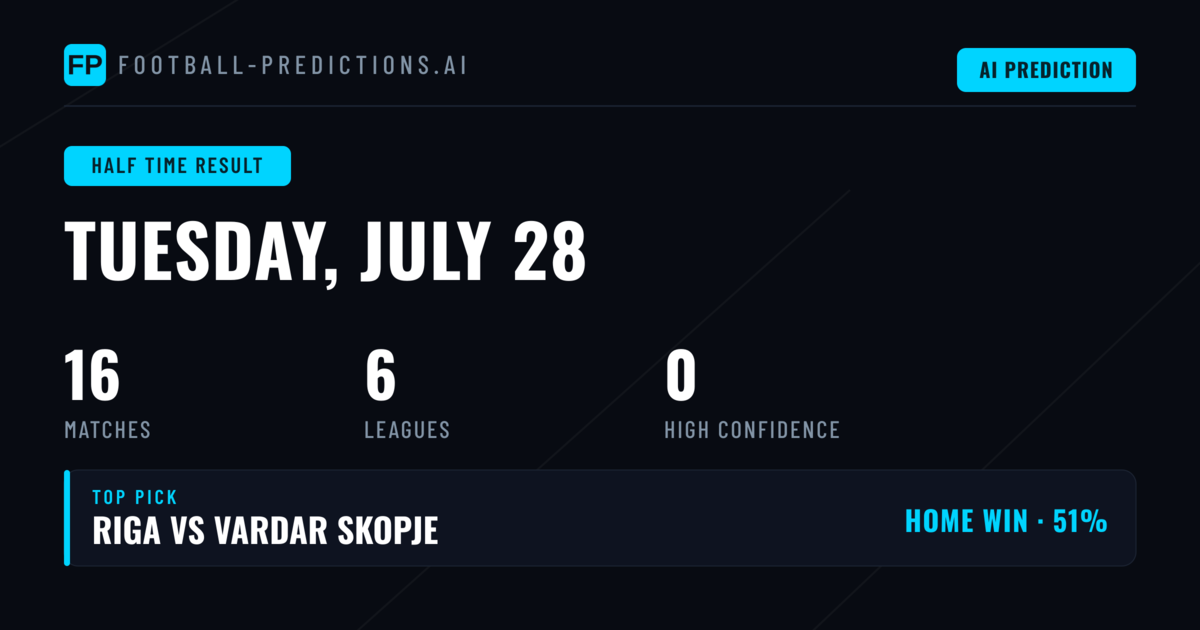

Football Predictions & Betting Tips: Jul 27 – Aug 2, 2026
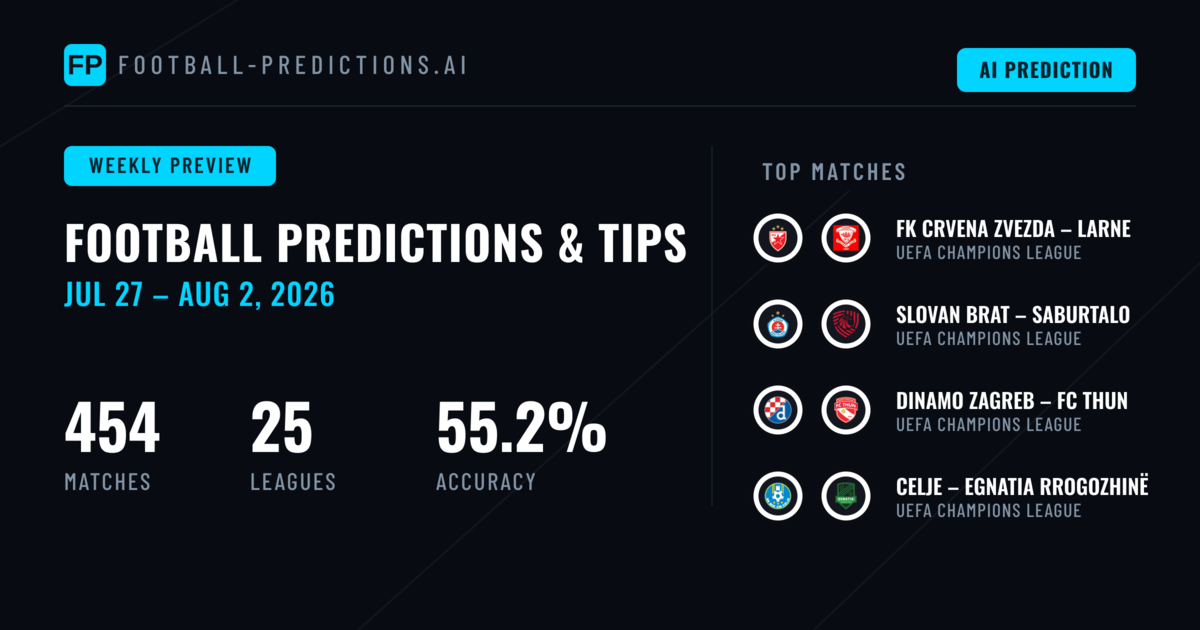
European Giants Enter the Arena as 454 Matches Light Up the Week
The European club season takes its first definitive steps this week as the UEFA Champions League and UEFA Europa League enter their qualifying rounds, headlining a staggering 454 fixtures across competitions worldwide. From the tension of knockout eliminators to league openers spanning multiple continents, the coming days deliver football's familiar rhythm returning to screens and stadiums alike.
Qualifying ties in European competition carry disproportionate weight. A single aggregate result can shape a club's entire financial and sporting trajectory for the season ahead, meaning teams approach these early rounds with measured caution. The Champions League path particularly demands attention, where clubs navigate compressed schedules against opponents who often specialize in disrupting favored opposition. The Europa League bracket runs concurrently, presenting its own tactical puzzles as teams balance domestic ambitions with continental survival.
Domestic action supplements the European calendar, with Scandinavian leagues and others entering early season phases. The volume—454 matches across seven days—creates a landscape where fixture density tests squad depth and tactical flexibility. Analysts tracking form across competitions face the challenge of separating genuine trends from limited sample sizes, particularly in leagues where clubs have completed only handfuls of competitive fixtures. The week ahead rewards systematic preparation and punishes assumptions based on last season's narratives.
Champions League and Europa League qualifiers dominate the midweek fixture list
Dinamo Zagreb Host FC Thun in UCL Second Round Qualifier
 vs
vs 
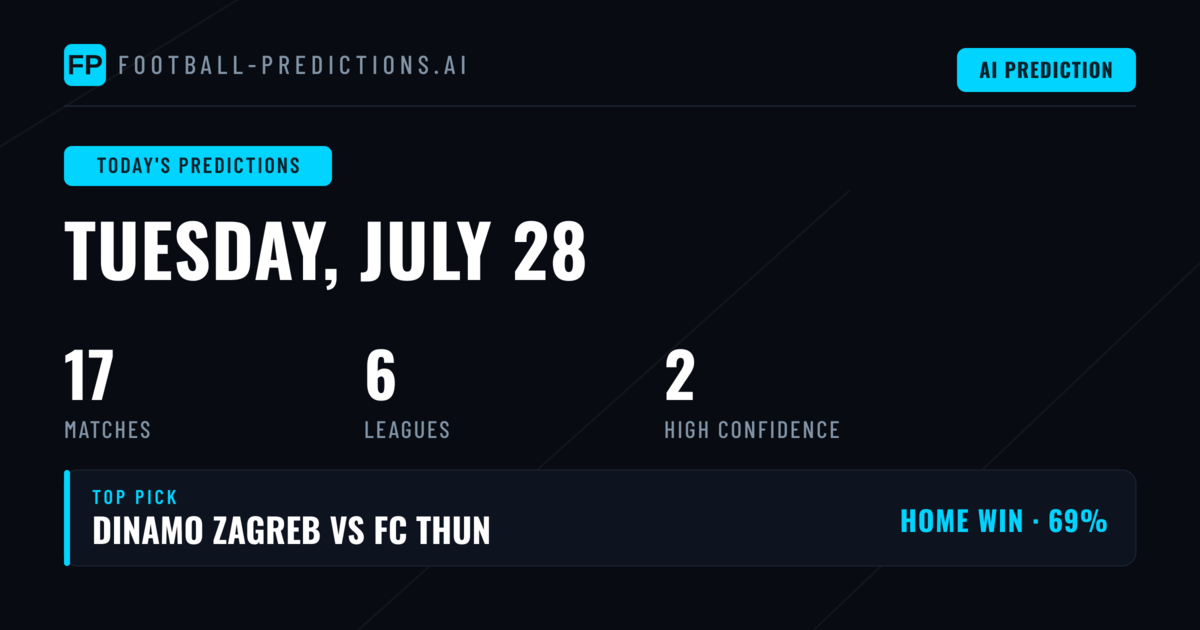
Tuesday's UEFA Champions League encounter sees Dinamo Zagreb, league rank #1 domestically, welcome FC Thun at Stadion Maksimir. The Croatian champions enter as clear favorites with a 69% confidence rating for a home win. The over 2.5 goals market carries 58% confidence while both teams scoring shows 51% — a coin-flip scenario. Dinamo Zagreb finished their domestic campaign as champions and will look to assert early dominance in this qualification round. Check the full Dinamo Zagreb vs FC Thun preview for detailed analysis.
Fenerbahçe Travel to Face Gornik Zabrze in UCL Qualifier
 vs
vs 
Gornik Zabrze, Poland's top-ranked side, face a stern test against Fenerbahçe on Wednesday. The Turkish visitors, sitting second in their league, are favored at 64% confidence despite playing away. Goals look likely with over 2.5 priced at 54% confidence and BTTS yes at 50%. The away side's quality in transition could prove decisive against a Gornik Zabrze defense that must be disciplined. For in-depth coverage, see our Gornik Zabrze vs Fenerbahçe betting tips.
PAOK Welcome Dynamo Kyiv in Europa League Qualifier
 vs
vs 
Thursday's Europa League action features a tightly contested matchup between PAOK and Dynamo Kyiv. Both clubs occupy identical third-place positions in their respective domestic leagues. PAOK hold a slim 53% edge for victory, with over 2.5 goals at exactly 50% and BTTS yes marginally ahead at 52%. The Greeks' home record will be crucial against a Dynamo Kyiv side accustomed to European competition. Read the complete PAOK vs Dynamo Kyiv prediction article.
Pafos FC Host HNK Hajduk Split in Europa League Clash
 vs
vs 
The Cyprus outfit Pafos FC, fourth in their domestic league, face Croatian second-placed side HNK Hajduk Split on Thursday. Despite the visitors' superior league position, Pafos are slight favorites at 53% confidence. The market suggests an open contest with over 2.5 goals at 50% and both teams scoring at 52%. Home advantage could prove pivotal for Pafos against an experienced Hajduk Split side. Access the full Pafos vs HNK Hajduk Split preview for our expert picks.
FC Midtjylland vs Beşiktaş — Thursday, July 30


FC Midtjylland finished second in their domestic league while Beşiktaş ended their campaign in fourth place. Both clubs enter this Europa League tie in qualification mode, with Thursday's first leg likely to set the tone for the aggregate. Midtjylland hold a 51% home win probability according to the model, marginally edging out a Beşiktaş side who must travel. The 56% confidence on over 2.5 goals and 58% for BTTS yes indicate expectations of an open contest. FC Midtjylland vs Beşiktaş
Anderlecht vs Hammarby FF — Thursday, July 30


Anderlecht ended their league season in fourth position, while Hammarby FF arrive in stronger form after finishing second. Thursday's Europa League qualifier pairs two clubs from contrasting domestic situations, making this a difficult tie to call. The model assigns just 42% confidence to a home Anderlecht victory, suggesting this remains genuinely competitive. Goals should flow freely with over 2.5 at 53% and BTTS yes at 57%. Anderlecht vs Hammarby FF
FK Crvena Zvezda vs Larne — Wednesday, July 29


The gap between these two clubs could hardly be wider. FK Crvena Zvezda enter as domestic champions following a first-place league finish, while Larne completed their season in ninth position. Wednesday's Champions League qualifier represents a significant step up in class for the visitors. An 88% home win confidence reflects the gulf in quality, with over 2.5 goals at 74% and a 64% no-BTTS pick supporting a one-sided outcome. FK Crvena Zvezda vs Larne
Hradec Králové vs Tromso — Thursday, July 30


This Europa League qualifier pairs fifth-placed Hradec Králové against a Tromso side who finished third in their own league, suggesting similar standards between the clubs. The model gives Tromso a 47% chance of taking an away victory, marginally ahead despite the travel involved. Over 2.5 goals sits at 51% with BTTS yes at 54%, pointing toward a close contest where small margins decide the outcome. Hradec Králové vs Tromso
European Football's Dual Narratives: Continental Competition Update
 UEFA Champions League
The 2025/26 UEFA Champions League season has reached its conclusion with Arsenal ascending to European football's highest throne. The Gunners' campaign delivered attacking football that kept supporters riveted throughout the competition, culminating in a historic triumph that marks a significant milestone for the club. Three clubs faced relegation from the competition following the conclusion of this season, underscoring the ruthless nature of elite European football where the margin between glory and disaster remains extraordinarily narrow.
 UEFA Europa League
The 2025/26 UEFA Europa League approaches its climax with 87 matches already played and just three fixtures remaining in what has been a compelling season. The competition has generated 225 goals at a rate that suggests attacking football has dominated the tournament, with dramatic late-stage encounters and fierce rivalries providing consistent entertainment. Those three remaining matches will determine the ultimate destination of the trophy and which club secures continental glory.
Simultaneously, the 2026/27 campaign is taking shape through qualifying rounds as clubs battle for places in the group stage. Six qualifying matches have produced 13 goals at an average of 2.17 per game, with home sides claiming nine of those goals compared to four for visiting teams. The early qualifying data indicates a pronounced home advantage in these preliminary rounds, a pattern that may influence how bettors assess first-leg matchups across the continent.
In-Form Sides Ready to Make Their Mark This Week
A handful of clubs enter the coming days carrying serious momentum, with their recent domestic league runs setting up intriguing assignments across multiple competitions.
 Inter Miami sit second in the MLS table with 37 points from 17 outings, boasting an enviable record of 11 wins, four draws and just two defeats. Their attack has fired 43 goals while conceding 30. A flawless run of five consecutive victories in their most recent league fixtures underlines their current trajectory. Lionel Messi leads their scoring charts with three goals across three appearances. The Herons will look to extend that sequence when they return to action this week.
 Belgrano Cordoba have turned heads early in the 2026/27 Liga Profesional campaign. One match played yields one win, two goals scored and one conceded, placing them second in the standings with three points. Their winning streak extends beyond that single fixture — five wins from their last five competitive matches overall. Lucas Gutierrez has been their most clinical outlet, finding the net twice across four appearances. They enter the new week with genuine belief after a statement start.
Dinamo Zagreb wrapped up the 2025/26 HNL campaign as runaway champions, accumulating 86 points from 36 matches with 27 wins, five draws and four defeats. They scored 93 goals and shipped just 28. Their recent domestic form showed one draw followed by four successive victories. Dinamo finished their league programme 24 points clear at the summit. Their attention now shifts to European competition, with a UEFA Champions League tie on the horizon. Dino Beljo finishes their season as their leading marksman with 11 goals from 21 appearances.
 FC Seoul wrapped their 2026/27 K League 1 season as deserving champions, sitting top of the table with 42 points from 19 matches. Their record read 13 wins, three draws and three defeats, complemented by 34 goals scored and 14 conceded. Across their final five league fixtures, they posted three wins, one draw and one defeat. With the domestic campaign concluded, they switch focus to the FA Cup for their next competitive assignment.
 Nashville SC have asserted themselves as the team to beat in MLS, occupying first place with 39 points from 17 games — 12 wins, three draws and two defeats. They have hit 33 goals while allowing only 12 at the other end. Their most recent league sequence shows one reversal followed by four wins on the bounce. Sam Surridge has been their sharpest weapon, contributing four goals from just two appearances. The Orange will back themselves to maintain their winning habit.
 Atletico Paranaense arrive in strong form for Serie A's latest round, positioned third with 36 points from 20 fixtures — 11 wins, three draws and six defeats. They have struck 28 times and conceded 19. A sequence of four wins and one draw from their last five league matches highlights their growing confidence. Sergio Mendoza leads their charge despite limited minutes, with one goal from a single appearance. They will aim to close the gap on those above them.
Premier Betting Picks: July 27 – August 2, 2026
Match Result (1X2)
The standout selection comes from the FK Crvena Zvezda vs Larne tie in the UEFA Champions League, where FK Crvena Zvezda win carries 88% confidence. Rapid Vienna faces FC Santa Coloma in the Conference League, with Rapid Vienna to win at 82% confidence. Both European heavyweights face opponents from lower-ranked nations.
Over/Under Goals
The FK Crvena Zvezda vs Larne Champions League fixture shows Over 2.5 goals at 74% confidence, suggesting attacking intent from the Serbian champions. In Argentina's Liga Profesional, Barracas Central vs Aldosivi leans toward Under 2.5 goals at 70% confidence, indicating a tighter contest.
Both Teams to Score
The Argentinos JRS vs Estudiantes de Rio Cuarto Liga Profesional clash shows Both teams to score: No at 66% confidence. Across the Atlantic, the Sporting Kansas City vs Houston Dynamo MLS fixture favors Both teams to score: Yes at 65% confidence in an anticipated high-scoring derby.
Double Chance
The FC Vaduz vs FC ST. Gallen Swiss Super League match offers draw or FC ST. Gallen (X2) at an exceptional 95% confidence. In South Korea, the Busan I Park vs FC Seoul FA Cup tie presents Busan I Park or draw (1X) at 95% confidence.
Asian Handicap
The FC Orenburg vs Zenit Russian Premier League match features Zenit -0.75 at a commanding 98% confidence. Zenit's quality advantage over Orenburg makes this the strongest single selection across all markets this week.
Half-Time / Full-Time
The Rapid Vienna vs FC Santa Coloma Conference League fixture projects Home / Home at 69% confidence. Rapid Vienna's anticipated dominance from the first whistle through to the final whistle reflects their significant class advantage over the visitors.
Correct Score
In the Argentinos JRS vs Estudiantes de Rio Cuarto Liga Profesional match, the Correct score prediction of 1–0 carries 26% confidence. This modest figure reflects the inherent difficulty of pinpointing exact margins in low-scoring encounters.
Half-Time Result
The Zira vs Paide UEFA Conference League qualifier shows Zira win at half-time at 59% confidence. Zira's early momentum positions them to hold an advantage at the interval against their Estonian opponents.
Corners
The Barracas Central vs Aldosivi Liga Profesional fixture favors Corners Under 9.5 at 70% confidence. Both Argentine clubs demonstrate disciplined defensive structures that limit corner-generating opportunities.
Cards
The CF Pachuca vs Club Queretaro Liga MX clash shows Cards Over 3.5 at 70% confidence. The rivalry between these Mexican clubs suggests an aggressive encounter with officials likely to produce multiple bookings.
Anytime Goalscorer
In the Cruz Azul vs Atlante FC Liga MX fixture, Gabriel Fernandez to score anytime carries 60% confidence. The forward's goal-scoring threat provides value in an anticipated attacking display from Cruz Azul at home.
Performance Review: Week of July 20–26
The week of July 20 produced solid results across most prediction categories. Our 1X2 selections returned 51.7% accuracy, landing 125 correct outcomes from 242 matches analyzed. The Over/Under markets proved more reliable, achieving 61.1% success with 143 correct calls from 234 matches, while BTTS predictions hit 60.7% accuracy (147 from 242). The average goal count across featured matches settled at 2.8 per game, with both teams scoring in 54.7% of fixtures.
When measured against our 90-day performance spanning 5376 predictions, last week slots into a broader pattern of variance and consistency. Our headline pick selections have delivered 61.6% accuracy over the longer sample, demonstrating that our filtering process identifies stronger signals than standard match result predictions alone (49.9%). The Over/Under channel at 61.1% last week marginally exceeded the 90-day average of 59.4%, while BTTS at 60.7% outperformed the 55.6% baseline. The standout remains Double Chance at 79.2% across 5376 predictions, illustrating the value in covering multiple outcomes when confidence warrants it.
The new week presents 454 upcoming matches across global competitions. Armed with these audited figures, our approach this cycle aims to replicate the Over/Under and BTTS strength while seeking improvement in match result precision. Each prediction category now carries verified performance data, allowing for sharper calibration as the fixture list unfolds.
Readers can study our complete track record across every bet type and tournament in the statistics section of our platform.
Half Time Predictions Today — AI-Powered First Half Tips
Table of Contents
- What Are Half Time Predictions?
- Half Time Statistics — Why Draws Dominate
- How Our AI Predicts Half Time Results
- Half Time Markets Explained
- Half Time Betting Strategies
- Finding Value in the Half Time Market
- Best Leagues for Half Time Betting
- Half Time in Accumulators
- Common Mistakes in Half Time Betting
What Are Half Time Predictions?
Half Time (HT) predictions forecast the score or result at the end of the first 45 minutes. The most common HT market is the Half Time Result — a 1X2 bet that settles at half time. You predict whether the home team leads (1), the match is level (X), or the away team leads (2) at the break.
This market differs fundamentally from full-time betting because first halves have their own unique dynamics. Teams tend to be more cautious in the opening period, managers make tactical adjustments at half time, and the psychological pressure of conceding first hasn't yet taken full effect. As a result, first halves produce fewer goals and significantly more draws than second halves — a statistical reality that creates systematic betting opportunities.
Other popular HT markets include Half Time Over/Under (usually 0.5 or 1.5 goals), Half Time Correct Score, and Half Time BTTS. These niche markets receive less bookmaker attention, meaning odds can be less efficiently priced — creating opportunities for model-driven bettors who specialize in first-half analysis.
The half time market has a distinct advantage for disciplined bettors: the result is known at half time, meaning your money is tied up for only 45-50 minutes rather than 90+. This faster turnover allows more bets per day and quicker bankroll growth when your edge is positive. It also eliminates the variance introduced by second-half events like red cards, penalties, and late goals.
Today, our AI has analyzed 15 matches across 5 leagues for HT predictions. The distribution: 6 predicted Home leads, 8 predicted HT Draws (53%), and 1 predicted Away leads. Our top pick is Riga vs Vardar Skopje — HT Home at 52% confidence.
The most striking feature of half time results is the overwhelming frequency of draws. Understanding this statistical reality is the foundation of profitable HT betting:
| League | HT Home Lead % | HT Draw % | HT Away Lead % |
|---|---|---|---|
| Premier League | ~33% | ~38% | ~29% |
| La Liga | ~34% | ~39% | ~27% |
| Bundesliga | ~32% | ~36% | ~32% |
| Serie A | ~31% | ~42% | ~27% |
| Ligue 1 | ~33% | ~41% | ~26% |
View full statistics across 5+ leagues →
The half time draw is the single most common result in football, occurring in 36-42% of all matches. Compare this with the full-time draw rate of 23-27% — the difference is dramatic. First halves average roughly 40% fewer goals than second halves, with most matches still level at the break.
This statistical reality has important implications. HT Draw odds typically range from 1.85-2.20 — and with a 38-42% base rate, this represents near-neutral or positive expected value even before any analytical edge. This is why the HT Draw is considered one of the best "blind" bets in football and the starting point for any HT betting strategy.
Serie A and Ligue 1 stand out with the highest HT Draw rates (40-42%), reflecting their traditionally defensive first-half approaches. The Bundesliga has the lowest HT Draw rate (~36%) and the highest HT Away Lead rate (~32%), reflecting its more open, attacking style from the first whistle. The Premier League sits in the middle, with a HT Draw rate of ~38% that has remained remarkably consistent over the past decade.
Another key statistic: approximately 30% of all matches are 0-0 at half time. This single scoreline — no goals at all — is the most common half-time outcome in world football. It accounts for the vast majority of HT draws and is driven by the conservative tactical approach most teams adopt in the opening 45 minutes.
How Our AI Predicts Half Time Results
Predicting half time results requires different analytical inputs than full-time predictions. Our model focuses on first-half-specific data rather than overall match statistics:
First-Half Scoring Patterns
Some teams are fast starters — scoring within the first 20 minutes regularly. Others take time to build into matches. We track first-half xG separately from second-half to capture this asymmetry. A team with 0.8 first-half xG per match is a very different HT proposition than one with 0.4, even if both average 1.5 xG per full match.
Tactical Approach Analysis
Managers known for cautious starts (sitting deep, absorbing pressure, counter-attacking) produce more HT Draws. Managers who press aggressively from kick-off produce more HT leads for their team. Our model profiles each manager's first-half tactical tendencies and weights them heavily in HT probability calculations.
Home Team First-Half Aggression
Home teams score first-half goals at a higher rate than away teams due to the crowd effect and the desire to establish control early. But this varies enormously — some home teams are notorious slow starters who come alive after half time. The model tracks each team's home first-half scoring rate separately from their away rate, capturing the venue-specific pattern.
Historical First-Half Data
We track each team's HT result distribution over the season. A team drawing at half time in 50% of their matches is a strong HT Draw candidate regardless of opposition quality. When two teams with high HT Draw rates meet, the probability of a HT Draw can exceed 50%, creating significant value at standard odds.
Match Importance Factor
High-stakes matches (cup finals, relegation deciders, title-deciding fixtures) tend to produce more cautious first halves, increasing HT Draw probability by 5-10%. Early rounds or dead rubbers can go either way, but our model adjusts for match importance based on league standings, cup round, and historical patterns in similar fixtures.
Half Time Markets Explained
Beyond the standard HT 1X2, bookmakers offer several specialized half time markets:
HT 1X2 (Half Time Result)
The standard market — predict Home lead, Draw, or Away lead at half time. Odds typically range from 1.85-2.20 for draws, 2.00-3.50 for home leads, and 3.00-6.00 for away leads. This is the most liquid HT market and the primary focus of our AI predictions.
HT Over/Under 0.5 Goals
Will there be at least one goal in the first half? HT Over 0.5 typically pays 1.30-1.45 and hits approximately 70% of the time. HT Under 0.5 pays 2.80-3.50 and hits about 30%. The under is the more interesting market for value seekers — in defensive matchups, Under 0.5 probability can reach 40%, making odds of 3.00+ very attractive.
HT Over/Under 1.5 Goals
This market asks whether there will be 2+ goals before the break. HT Over 1.5 typically pays 2.50-3.50 and hits 30-35% of the time. It requires a fast-paced, open first half. Target matches between attacking teams with weak defenses — Bundesliga and Eredivisie fixtures are prime candidates for this market.
HT Correct Score
Predict the exact score at half time. With fewer goals scored in first halves, the distribution is more concentrated: 0-0 occurs ~30% of the time, 1-0 ~18%, 0-1 ~14%, 1-1 ~12%. This concentration makes HT Correct Score more predictable than FT Correct Score. 0-0 HT at odds of 2.80-3.20 is one of the most reliable single-outcome bets in football.
HT Both Teams to Score
Will both teams score in the first half? This is a low-probability event — occurring in only 18-22% of matches. HT BTTS Yes typically pays 3.50-5.00, making it a high-odds market. Target open, attacking matchups where both teams have first-half scoring records above 60%. Avoid defensive leagues entirely for this market.
Half Time Betting Strategies
1. The HT Draw Specialist
Focus exclusively on HT Draws. Select 2-4 matches per day where our model rates HT Draw above 42%. At average odds of 2.00-2.10, you need roughly a 48-50% hit rate to profit. With the base rate already at 38-42%, a model that adds even a small edge makes this strategy consistently profitable. This is the simplest, most robust HT strategy available.
To refine this strategy, target matches between evenly-matched teams in defensive leagues. When the pre-match 1X2 odds are close (e.g., Home 2.40, Draw 3.20, Away 3.00), the HT Draw probability typically exceeds 43%. Add the filter of both teams having low first-half xG (below 0.7), and you're looking at HT Draw probabilities above 48%.
2. First-Half Goal Rush
Target HT Home leads in matches where the home team is a fast starter (scores first-half goals in 60%+ of home matches) and the away team is a slow starter (concedes first-half goals in 50%+ of away matches). These convergence patterns significantly boost HT Home probability above the league average of ~33%. At HT Home odds of 2.20-2.80, a 40%+ hit rate generates strong returns.
3. The HT/FT Connection
If you predict a HT Draw, you can extend this into the more profitable HT/FT market. HT Draw + FT Home Win (X/1) is one of the most popular and profitable HT/FT outcomes, occurring when the home team comes from behind or breaks a deadlock in the second half. If your HT analysis points to a draw, consider whether the home or away team is more likely to win the match — then play the corresponding X/1 or X/2 in HT/FT for significantly higher odds.
4. HT Over/Under 0.5
HT Under 0.5 goals (no goals in the first half) wins roughly 30% of the time across top leagues but can offer odds of 2.80-3.50. In defensive matchups — particularly in Serie A and low-scoring leagues — this percentage rises to 35-40%, creating significant value at those odds. Conversely, HT Over 0.5 at 1.35-1.45 is a reliable accumulator leg that hits 70% of the time.
5. The 0-0 HT Correct Score Play
0-0 at half time occurs in ~30% of all matches but at higher rates in specific contexts: defensive derbies (35-40%), matches between low-xG teams (38-42%), and matches in defensive leagues like Serie A (33-36%). At odds of 2.80-3.20, this is one of the rare bets where the base rate alone approaches profitability. With selective match filtering, 0-0 HT becomes a reliable high-frequency strategy.
Do
- Focus on HT Draw — the most predictable HT outcome
- Track each team's first-half scoring patterns separately
- Consider manager tactical tendencies in opening periods
- Use HT Under 0.5 in defensive matchups for value
- Combine HT analysis with HT/FT for bigger returns
- Specialize in 2-3 leagues with clear HT patterns
Don't
- Apply full-time logic to half time predictions
- Assume the favorite always leads at HT — they don't 50-60% of the time
- Ignore league-specific HT draw rates (36% in Bundesliga vs 42% in Serie A)
- Overbet HT Home/Away at short odds — margins are tighter here
- Forget that first halves have their own dynamics separate from full matches
- Use full-match xG for HT predictions — use first-half xG specifically
Finding Value in the Half Time Market
The HT market is less efficiently priced than full-time markets for several important reasons:
Lower Betting Volume
Fewer bettors focus on HT, meaning bookmaker odds adjust more slowly to new information and model predictions. When a key player is injured or a tactical change is announced, full-time odds move within minutes — but HT odds may not adjust for hours. This lag creates exploitable windows.
Less Public Data
While full-time statistics are widely available, first-half specific data is harder to find — giving model-driven bettors an information advantage. Most public prediction sites don't separate first-half and second-half analysis, meaning our AI's first-half-specific modeling provides a genuine edge.
Bookmaker Focus Elsewhere
Bookmakers devote their best pricing algorithms to 1X2 and Over/Under. HT markets often carry wider margins but also wider mispricings. The overround on HT 1X2 is typically 8-12%, compared to 4-6% on FT 1X2. But within that wider margin, individual outcomes can be significantly mispriced.
Public Bias Against Draws
Casual bettors overestimate how often the better team leads at half time, creating value on HT Draws and HT Away leads. The public perception is that a team at 1.60 to win the match will "obviously" lead at half time — but in reality, even strong favorites are level at half time in 45-55% of their matches. This persistent public bias keeps HT Draw odds attractive.
Best Leagues for Half Time Betting
League selection is critical for HT betting success. Different leagues produce dramatically different first-half dynamics:
| League | HT Draw Rate | Best HT Market | Character |
|---|---|---|---|
| Serie A | 42% | HT Draw / HT U0.5 | Defensive, tactical first halves |
| Ligue 1 | 41% | HT Draw | Conservative openers, PSG exception |
| La Liga | 39% | HT Draw / 0-0 HT CS | Possession-heavy, slow builds |
| Premier League | 38% | HT Draw / HT Home | Balanced, some fast starters |
| Bundesliga | 36% | HT Over 1.5 | Open, attacking from minute 1 |
| Eredivisie | 35% | HT Home / HT Over | High-scoring, less defensive |
| Championship | 39% | HT Draw | Physical, cagey first halves |
For HT Draw specialists, Serie A, Ligue 1, and the Championship offer the best opportunities. For HT Over bettors, the Bundesliga and Eredivisie's attacking first halves provide consistent value. The Premier League is versatile — it works for multiple HT strategies depending on the specific matchup.
Half Time in Accumulators
HT selections can be excellent accumulator components, particularly HT Draws and HT Over 0.5 goals:
| Strategy | Legs | Avg Odds | Combined | Est. Hit Rate |
|---|---|---|---|---|
| HT Draw treble | 3 | 2.00 | 8.00 | ~7% |
| HT Draw double | 2 | 2.00 | 4.00 | ~17% |
| Mixed HT + FT selections | 3 | 1.80 | 5.83 | ~12% |
| HT Over 0.5 (safe legs) | 4 | 1.38 | 3.63 | ~30% |
HT Draw doubles are the sweet spot — two selected HT Draws at 2.00 each give you a 4.00 return with a realistic ~17% chance of landing. Over 100 doubles, even a modest analytical edge produces clear profit. Trebles are more volatile but the 8.00 odds make them attractive for smaller stakes.
HT Over 0.5 is the ultimate "safe" accumulator leg. At 1.35-1.45 per leg, four selections produce combined odds of 3.30-4.40 with a ~30% hit rate. These legs are particularly reliable in attacking leagues (Bundesliga, Eredivisie) and in matches with high expected goals. While the individual odds are low, the compounding effect in 4-5 leg accas creates meaningful returns with high consistency.
Mixing HT and FT selections in the same accumulator provides diversification — HT results are partially independent of FT results (a HT draw doesn't determine who wins). This makes HT+FT accas more robust than pure FT accas where all legs are correlated through similar market dynamics.
Build an accumulator with AI-rated picks →
Common Mistakes in Half Time Betting
Avoiding these errors will significantly improve your HT betting performance:
- Assuming the better team leads at HT: Even strong favorites are level or behind at half time in 50-60% of their matches. A team with 70% full-time win rate might only lead at HT in 35-40% of games. First halves are more equal than full matches — this is the fundamental insight of HT betting.
- Ignoring first-half specific data: A team's overall scoring rate is not the same as their first-half scoring rate. Some teams score 80% of their goals in the second half — making them poor HT Home/Away candidates but excellent HT Draw selections. Always use first-half-specific statistics.
- Overlooking the 0-0 HT frequency: Approximately 30% of all matches are 0-0 at half time. This single scoreline accounts for the majority of HT Draws and represents the most predictable single outcome in football betting. If you're not considering 0-0 HT as a core bet, you're missing the most reliable pattern.
- Using full-time odds logic: HT odds are structured differently. HT Home at 2.20 is not "generous" the way FT Home at 2.20 would be — because HT Home only occurs 33% of the time. Always calibrate your value assessment against HT-specific base rates, not FT rates.
- Not considering managers' tactical setups: Some managers are known for conservative first halves followed by aggressive second halves. Teams under these managers are systematic HT Draw generators — and this pattern often isn't reflected in HT odds because bookmakers focus more on team quality than tactical approach.
- Betting HT in unpredictable contexts: Cup matches with heavy rotation, pre-season friendlies, and matches with no competitive significance produce less predictable HT results because teams deviate from their normal tactical patterns. Stick to competitive league matches where patterns are most reliable.
View today's half time prediction for every football match. Our AI analyses first-half scoring patterns, early goal tendencies and historical HT data to deliver accurate first half predictions. Need a first half draw prediction? Draws at half time occur in 40-50 % of matches — our model identifies which games are most likely to be level at the break. Half time predictions today offer higher odds than full-time markets, with first half over 1.5 prediction and first half over 2.5 prediction also available.
Half Time Predictions FAQ
What are half time predictions?
Half time predictions forecast the result at the break — Home leading (1), Draw (X), or Away leading (2). Today 8 of 15 matches (53%) are predicted HT Draw across 5 leagues.
How often is it a draw at half time?
Approximately 38-42% of all football matches are level at half time, making HT Draw the most common HT result. In Serie A and Ligue 1, the rate reaches 40-42% due to defensive first-half approaches.
Is half time draw a good bet?
HT Draw is statistically one of the most reliable bets, occurring in 38-42% of matches with typical odds of 1.90-2.20. You need roughly a 48% hit rate to profit at odds of 2.05. Our top HT pick today is Riga vs Vardar Skopje — HT Home at 52% confidence.
What factors affect half time results?
First-half scoring patterns, tactical approach (cautious vs aggressive starts), home team first-half record, and match importance all affect HT outcomes. Our AI analyzes these for 15 matches today across 5 leagues.
Can I combine half time bets in accumulators?
Yes — HT selections work well in accumulators. HT Draw doubles at average 2.00 odds give 4.00 returns with ~17% probability. HT Over 0.5 at 1.35-1.45 is excellent as a safer accumulator leg.
How is half time betting different from full time?
First halves produce fewer goals and more draws than second halves. The HT Draw rate is 38-42% vs 25% for full time. Teams are more cautious early, and many goals come after half-time tactical adjustments. HT markets require different analysis than FT.