


 Liga MX
 Scottish Premiership

 Superliga


 Primeira Liga

 HNL
HNL

 Liga I
 Ekstraklasa

 Czech Liga

 First League

 Super Lig
 MLS Predictions
 New York City FC
 New York Red Bulls
 San Jose Earthquakes
 Los Angeles FC
 CF Montreal
 Columbus Crew
 New England Revolution
 Orlando City SC
 DC United
 Charlotte
 US Open Cup Predictions
View all US Open Cup predictions 

 CONMEBOL Libertadores Predictions
 LDU de Quito
 Palmeiras
 Corinthians
 Estudiantes L.P.
 Flamengo
 Independiente del Valle
 UEFA Europa League Predictions
 AC Milan
 Benfica
 Anderlecht
 Lyon
Lyon Bayer Leverkusen
 Celje
Celje Hapoel Beer Sheva
 Dinamo Zagreb
 Olympiakos Piraeus
 Jagiellonia
 Premier League Predictions
 Brentford
 Chelsea
 Tottenham
 Aston Villa
 Brighton
 Arsenal
 Everton
 Ipswich
 Newcastle
 Hull City
 Serie A Predictions
 Monza
Monza Sassuolo
 Bologna
 Torino
 Udinese
 Cagliari
 AS Roma
 Inter
Inter Venezia
 Lazio
Lazio La Liga Predictions
 Atletico Madrid
 Osasuna
 Deportivo La Coruna
 Sevilla
 Barcelona
 Racing Santander
 Levante
 Athletic Club
 Real Betis
 Getafe
 Bundesliga Predictions
 Bayern München
 Union Berlin
 Eintracht Frankfurt
 SC Freiburg
 Hamburger SV
 1. FC Köln
 Werder Bremen
 FC Augsburg
 Borussia Mönchengladbach
 FSV Mainz 05
 Ligue 1 Predictions
 Monaco
 Lens
Lens Paris FC
 Strasbourg
 Angers
 Estac Troyes
 Le Mans
 LorientLyon
 Rennes
Past Predictions
 Ararat-Armenia
 Sparta Praha
 Omonia Nicosia
 Celta Vigo
 Platense
 Fluminense
 Elche
Elche Real Madrid
 Alaves
 Valencia
 Rayo Vallecano
 Espanyol
 LeedsNewcastle
 VillarrealReal BetisInterUdinese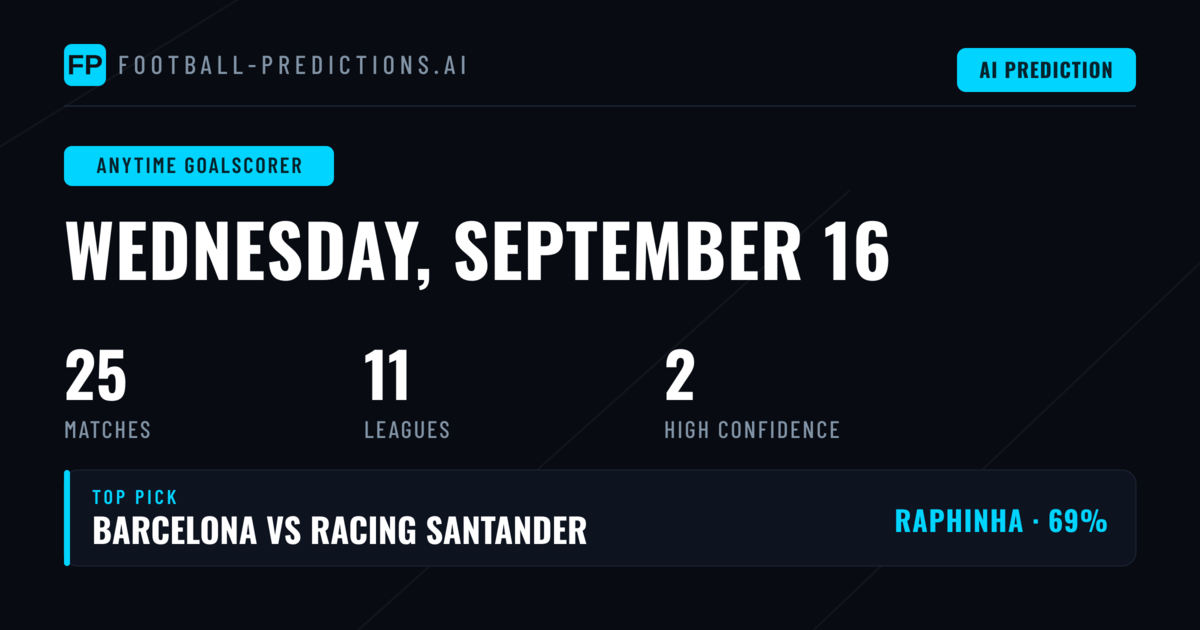

Football Predictions & Betting Tips: Sep 14 – Sep 20, 2026
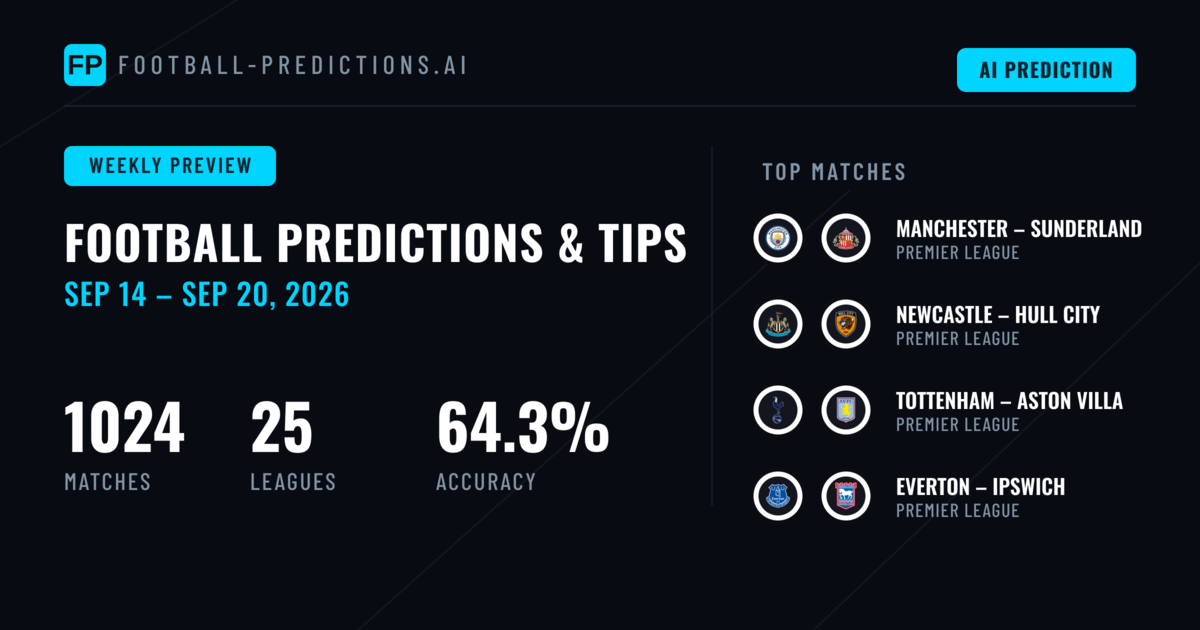
The Week Ahead: 1,024 Matches Set to Light Up Global Football
Football supporters across every continent face a feast of action this week as 1,024 matches populate the calendar from September 14 through September 20, 2026. The scope spans elite continental competitions, domestic cup action, and league fixtures across multiple countries, ensuring that armchair analysts and bettors alike will find no shortage of opportunities to assess form, fitness, and fixture congestion.
Among the standout competitions drawing attention this week, the UEFA Europa League continues its group stage with several teams looking to establish early command of their pools. South American club football's premier competition, the CONMEBOL Libertadores, also enters a crucial phase with several sides jostling for position in their respective groups. Domestically, English and Italian clubs turn their focus to cup matters, with the FA Cup and Coppa Italia producing early-round eliminators that offer smaller clubs the chance to test themselves against top-flight opposition.
With such a densely packed schedule, the week presents unique analytical challenges. Teams operating across multiple competitions must carefully manage squad rotation, while others may find themselves navigating congested fixture lists with minimal recovery time between outings. The geographical spread of matches means that analysis must account for varying conditions, travel demands, and the impact of recent international duty on player availability. These factors combine to create a landscape where unexpected results become not merely possible but statistically probable across the 1,024 encounters scheduled.
Midweek European and South American Showdowns Take Center Stage
The week ahead delivers a compelling mix of UEFA Europa League action and CONMEBOL Libertadores drama. From Mediterranean clashes to Balkan encounters and South American battles, these four fixtures pit teams in contrasting domestic situations against each other with plenty at stake in continental competition.
Hapoel Beer Sheva vs Dinamo Zagreb
 vs
vs 
A significant gap in current domestic form sets the tone for Wednesday's Europa League opener. Hapoel Beer Sheva vs Dinamo Zagreb sees the Croatian champions arrive in third place domestically while Hapoel sit third in their own league. The head-to-head record between these sides shows one draw and one away victory across two meetings, averaging 4.5 goals per encounter. Our model predicts a home win at 50% confidence, with both teams failing to score at 62% confidence. The high-scoring nature of their previous meetings suggests one goal may decide this contest.
Levski Sofia vs Red Bull Salzburg
 vs
vs 
Thursday brings a fascinating encounter as league leaders Levski Sofia welcome a Red Bull Salzburg side sitting third in their domestic standings. Levski Sofia vs Red Bull Salzburg presents a genuine tactical puzzle. Our model indicates a draw as the most likely outcome at 33% confidence, with under 2.5 goals backed at 57% and both teams to score evenly split at 50%. Salzburg's European pedigree gives them a slight edge on paper, but Levski's domestic dominance cannot be dismissed. Expect a tightly contested affair with few clear-cut chances.
Celtic vs Ferencvarosi TC
 vs
vs 
Celtic's domestic invincibility should carry them through Thursday's Europa League test against Ferencvarosi TC. Celtic vs Ferencvarosi TC sees the Scottish champions clear favorites with a home win predicted at 50% confidence. Ferencvarosi TC sit fifth in their league, creating a disparity in current form. The under 2.5 goals market carries the highest confidence of the week at 63%, while BTTS no receives 56% backing. Celtic have won two of their three previous meetings with Ferencvarosi, averaging 3.3 goals across those clashes. The Hungarian visitors must tighten their defensive shape significantly to avoid another setback.
Platense vs Fluminense
 vs
vs
Tuesday's Libertadores action delivers a battle between South American giants and domestic outsiders. Platense vs Fluminense features a side thirteenth in their league hosting the league leaders. Despite Fluminense's commanding domestic position, our model favors a draw at 33% confidence. The under 2.5 goals market receives 54% backing, while BTTS yes carries 60% confidence — the highest such figure across all four featured matches. This signals a contest where both defenses may bend but not completely break. Fluminense's superior quality should eventually tell, though Platense possess enough to trouble the Brazilian league leaders.

 AC Milan vs Benfica
Benfica travels to San Siro on Wednesday with the stronger league position, sitting second in the Portuguese top flight compared to AC Milan's fifth-place standing in Serie A. The data favors an away victory with 50% confidence, while the under 2.5 goals market shows stronger conviction at 60%. Neither side appears likely to score, with BTTS marked at 52% confidence against. Their sole previous meeting produced just one goal. A tight, low-scoring affair suits Benfica's current trajectory.

 Corinthians vs Estudiantes L.P.
Thursday's CONMEBOL Libertadores encounter sees Estudiantes L.P. backed to win despite sitting five places below Corinthians in their domestic league. The away side carries 45% prediction confidence into this fixture. Goals should be limited, with under 2.5 markets at 55%, though both teams finding the net remains the preferred outcome at 59%. The two-team head-to-head history shows one win each with an average of 1.0 goals per match.

 Sturm Graz vs Rennes
A draw emerges as the most likely outcome for this UEFA Europa League clash on Wednesday, with both teams occupying similar league positions—Sturm Graz fourth in Austria and Rennes third in Ligue 1. The prediction carries 33% confidence in a stalemate. Defensive solidity should prevail, with BTTS at 62% confidence for no goals from either side. Rennes' away form will face a stern examination against a well-organized Sturm Graz side on home soil.

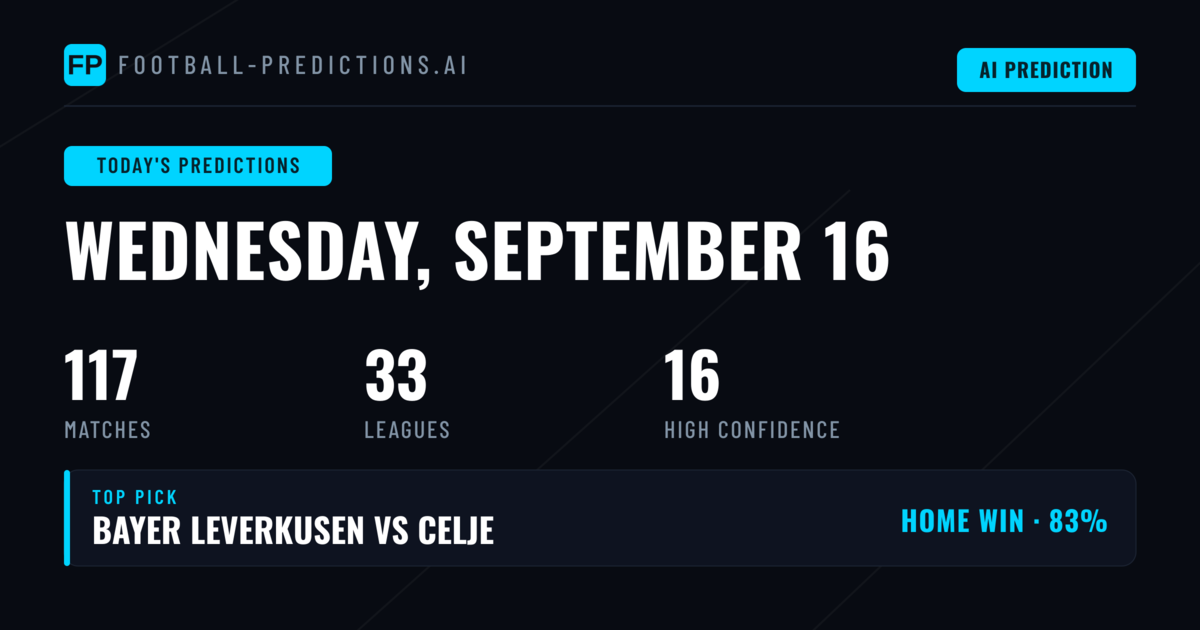
 Bayer Leverkusen vs Celje
The Bundesliga side hosts the Slovenian league leaders in a compelling UEFA Europa League fixture. Celje's top domestic standing makes this an intriguing underdog test against Leverkusen in seventh place. A draw registers at 33% confidence, suggesting a closely contested match in Germany. Both teams to score carries 62% confidence against, indicating expected defensive discipline. Celje's league-best record suggests they possess the quality to frustrate their higher-profile opponents.
Cup Competitions: Where Goals Flow and Giants Fall
 FA Cup
The 2025/26 FA Cup campaign confirmed why England's historic knockout competition remains the benchmark for dramatic cup football. Across 812 matches throughout the season, the tournament produced a remarkable 3.32 goals per game, a figure that consistently rewarded Over bettors while leaving defensive teams scrambling for solutions at every level of the English football pyramid. Home teams secured 1504 victories over the course of the campaign, illustrating the continued importance of home advantage even as lower-league clubs pushed established names to their limits. The combination of high-scoring encounters and unpredictable outcomes made the FA Cup a fertile hunting ground for those tracking attacking trends across domestic cup competitions.
 Coppa Italia
The Coppa Italia 2025/26 season carved its place in the record books as one of the most prolific attacking tournaments in recent memory. Thirty-three matches generated 91 goals at an average of 2.76 per game, a total that dwarfed typical cup norms and suggested a tournament where defensiveOrganisation took a back seat to entertainment. The 2026 edition continues this trajectory, with the attacking verve that defined the previous season showing no signs of diminishing as new contenders enter the fray. Teams progressing through the Coppa Italia this week will need to balance their natural attacking instincts with the tactical discipline required for cup survival, a challenge that has proven difficult for many throughout this exceptionally high-scoring cycle.
 CONMEBOL Libertadores
The CONMEBOL Libertadores 2026/27 campaign reaches its decisive phase with 118 matches already completed and the tournament at 83 percent completion. The group stage standings reveal a familiar pattern of South American giants asserting their authority alongside a handful of determined challengers. Flamengo sits atop the table with 16 points from six matches, having won five of their six encounters while suffering no defeats. Independ. Rivadavia matches Flamengo's tally exactly, also collecting 16 points through five wins and a single draw in their six fixtures. Both clubs carry identical form guides of WWDWW into their upcoming matches, suggesting momentum that could prove decisive as the group stage reaches its climax.
Below the leaders, U. Catolica holds third place with 13 points from four wins, one draw, and one defeat in their six matches. Corinthians occupies fourth position on 11 points, though their three wins, two draws, and single loss indicate a campaign that has lacked the consistency of the frontrunners. Coquimbo Unido rounds out the leading pack with 10 points, their campaign featuring three wins against two losses from six fixtures. The form guide of LWWLW suggests a team capable of building sequences but occasionally vulnerable to the intensity that defines continental competition at this stage. As the group stage enters its decisive phase, the tactical adjustments and squad rotation decisions made over the coming days will determine which of these five clubs advances with momentum rather than merely survival on their side.
In-Form Teams Lighting Up European Football
Several clubs enter the week riding remarkable unbeaten streaks, combining relentless attacking output with defensive solidity that has left opponents struggling for answers across domestic leagues. With 1024 fixtures scheduled between September 14-20, 2026, these sides represent the form teams worth tracking for any football enthusiast or analyst.
Celtic have set the benchmark in Scotland, sitting top of the Scottish Premiership with 18 points from 6 matches. Their record reads six wins from six attempts, conceding just three goals while finding the net 14 times. The attacking verve has been spearheaded by K. Høgh, who has plundered three goals in only two appearances. Celtic's domestic dominance now faces a different test as they prepare for UEFA Europa League action this week, with their first continental assignment presenting fresh tactical challenges.
 FC Porto mirror Celtic's perfection in Portugal, also collecting 18 points from six games with an identical six-win sequence. The Dragons have been particularly miserly at the back, shipping just two goals while rattling in 15 at the other end. Gabri Veiga has contributed one goal and one assist across two substitute appearances, suggesting creative threat from the bench. Porto's all-round Primeira Liga display positions them as heavy favourites whenever they next take domestic field.
 PSV Eindhoven lead the Eredivisie with 16 points from six matches, their record of five wins and one draw reflecting continued domestic authority. The Dutch outfit boast the most prolific attack among these form teams, plundering 22 goals already, though their defensive record of seven conceded shows occasional vulnerability. S. Dest has registered once in a single appearance, indicating goals are distributed across the squad. PSV take their momentum into another fixture this week, seeking to extend their advantage at the summit.
 Barcelona have made an explosive start to their La Liga campaign, collecting 15 points from five matches courtesy of five consecutive victories. Their goal difference reads an eye-watering plus-17, with 21 scored and four conceded, making them the most clinical outfit in Europe's top leagues relative to games played. Raphinha leads their charge with two goals and one assist from a single appearance, demonstrating immediate impact. Barcelona's relentless early-season form marks them as the team others must chase in Spain.
Benfica sit second in the Primeira Liga on 16 points, one behind rivals Porto, with their record showing five wins and one draw from six attempts. The Eagles have been equally devastating in attack, hitting 21 goals while conceding just four. V. Pavlidis has been clinical in front of goal, netting five times alongside one assist in just three appearances. Benfica now turn their attention to UEFA Europa League competition this week, where their domestic sharpness will face continental examination.
 Anderlecht begin their European journey this week in the Europa League, entering the group stage fresh from domestic success. The Belgian side had built a five-win sequence domestically before their focus shifted to continental matters. A. Bertaccini had found the net once across two appearances in prior competition, and the squad will aim to transfer domestic confidence onto the European stage when they face Celtic in their opening group fixture.
Reviewing Last Week's Predictions: A Mixed Week Across the Board
The week of Sep 7 to Sep 13 delivered a challenging test for our predictive model, with overall results reflecting the inherent unpredictability of competitive football. The 1x2 market proved particularly difficult, with our model landing 277 correct predictions out of 661 matches, translating to an accuracy of 41.9%. This represented a dip below our typical performance threshold, a reminder that even the most refined statistical models encounter stretches where results diverge from expectations.
More encouraging signals emerged in the goal markets. The Over/Under category performed solidly at 57.8% accuracy, with 338 correct calls from 585 predictions, while BTTS predictions hit the mark 54.6% of the time across 661 fixtures. The average goals per match stood at 2.92, and both teams found the net in 55.6% of fixtures, indicating a week characterised by attacking intent rather than defensive solidity across many competitions.
Placed against our longer-term track record compiled over approximately 90 days and 6,514 predictions, last week's 1x2 figure of 41.9% sits below the 48.8% baseline we have established over that sample. However, the Over/Under result at 57.8% came within touching distance of our 90-day figure of 58.2%, while the headline pick accuracy of 58.9% over the longer window provides a reliable anchor point for confidence. The Double Chance market has historically been our strongest performer at 75.9% across the 90-day window, a testament to the value of covering multiple outcomes in uncertain fixtures.
As we turn our attention to the 1,024 matches scheduled for this week, our model continues to process fresh data and recalibrate its outputs. The statistical foundations remain robust, and short-term variance is factored into our methodology. On our statistics page you can study our performance in detail across every bet type and in the context of all tournaments.
Goal Scorer Predictions — AI-Powered Anytime Scorer Tips
Table of Contents
- What Are Goal Scorer Predictions?
- How Our AI Selects Goal Scorers
- Today's Goal Scorer Predictions
- Types of Goal Scorer Bets
- Key Metrics for Goal Scorer Analysis
- Goal Scorer Betting Strategies
- Penalties and Set Pieces
- Common Mistakes in Scorer Betting
- Goal Scorer Accumulators
What Are Goal Scorer Predictions?
Goal scorer betting is one of the most exciting and potentially lucrative markets in football. Instead of predicting match outcomes or total goals, you're predicting which specific player will find the net. This market appeals to fans who follow teams closely and understand player form, positioning, and set-piece duties — knowledge that translates directly into betting edge.
Our AI system goes beyond simple "top scorer" selections. It analyzes expected goals (xG) data, shot volumes, penalty duties, set-piece responsibilities, and opponent defensive vulnerabilities to identify the most likely scorers in every match. The result is a data-driven selection that combines statistical modeling with tactical context.
Goal scorer markets typically offer higher odds than standard match betting, reflecting the inherent difficulty of predicting exactly who will score. However, this difficulty is partly illusory — in many matches, a handful of players account for the vast majority of goal probability. By focusing on these high-probability scorers and identifying when the odds undervalue them, our AI finds consistent value in this market.
The market is also less efficient than match results or over/under goals. Bookmakers allocate less modeling resource to individual player markets, creating wider margins but also more opportunities for informed bettors. Our AI systematically identifies these pricing gaps by comparing our projected scoring probability against offered odds.
Goal scorer betting also has a unique psychological appeal — it connects you directly to individual performances rather than abstract outcomes. Watching "your" player hunt for a goal creates engagement that no other market matches. This emotional connection, combined with the analytical depth available through xG data and set-piece tracking, makes goal scorer one of the most rewarding markets for bettors who invest time in research.
How Our AI Selects Goal Scorers
The goal scorer prediction engine uses a multi-layered approach to identify the most likely scorers in each match:
Expected Goals (xG) profile: The model starts with each player's xG per 90 minutes — a measure of the quality and quantity of their shooting opportunities. Strikers who consistently get into high-xG positions (close to goal, central, one-on-one) are naturally more likely to score than those who shoot from distance.
Shot volume and conversion: Beyond xG, the model tracks actual shot volume and conversion rates. Some players consistently outperform their xG (elite finishers), while others underperform. The model adjusts for these individual tendencies rather than assuming all players convert at the same rate.
Set-piece duties: Penalty takers, direct free-kick specialists, and players who attack the near post on corners have additional scoring avenues beyond open play. Our AI identifies current set-piece duties and adds the corresponding goal probability. A penalty taker adds roughly 0.08-0.12 goals per match from penalties alone.
Opponent defensive weaknesses: The model assesses the opposing team's defensive vulnerabilities — do they concede from set pieces? Are they weak against pace on the counter? Do they leave space between the lines? Players whose strengths match the opponent's weaknesses receive a probability boost.
Recent form and minutes: A player's last 5 matches carry more weight than season averages. A striker who has scored in 3 of the last 4 matches is in a different psychological and tactical state than one in a 10-match drought. The model also accounts for expected minutes — a player likely to be substituted at 60 minutes has lower scoring probability than a guaranteed 90-minute starter.
Today's Goal Scorer Predictions
Today our system is analyzing 103 matches across 29 leagues, with goal scorer predictions for 25 fixtures. Each prediction identifies the player most likely to score and provides confidence ratings and available odds.
| Metric | Value |
|---|---|
| Total matches analyzed | 103 |
| Leagues covered | 29 |
| Scorer predictions | 25 |
| Top predicted scorer | Patrik Schick (Bayer Leverkusen vs Celje) |
| Highest confidence | 75% |
| Best odds available | 3.40 |
Track our goal scorer prediction accuracy and other bet type performance on our statistics page.
Types of Goal Scorer Bets
Bookmakers offer multiple goal scorer market variations, each with different risk/reward profiles:
Anytime Goal Scorer
The most popular market — your selected player just needs to score at least once during the match (including extra time). This is the highest-probability scorer bet and the one our AI primarily targets. Typical odds range from 1.80 for prolific strikers to 5.00+ for midfielders and defenders.
First Goal Scorer
A higher-odds market where you predict who will open the scoring. This adds the timing element to the difficulty. Penalty takers and early-pressing teams' forwards are good candidates. Odds are typically 2-3x higher than anytime scorer odds for the same player.
Last Goal Scorer
Predict the final scorer in the match. Substitutes who come on fresh in the last 20-30 minutes can be valuable here, especially impact strikers brought on to chase the game. This is often an overlooked market with pricing inefficiencies.
Two or More Goals (Brace)
Your player must score at least twice. This market requires a combination of high shot volume, good finishing, and favorable opposition. Only the very top strikers — think Haaland, Mbappé, or their equivalents — are realistic two-goal threats in most matches. Odds typically range from 5.00 to 15.00.
Hat Trick
Three or more goals from one player. This is essentially a lottery ticket with odds often exceeding 20.00. While fun, it is extremely difficult to predict consistently. Focus on matches where a top striker faces a very weak defense in a match with high expected goals. Hat tricks occur in approximately 1-2% of matches.
Scorecast (First Scorer + Correct Score)
A combination bet where you predict both the first goal scorer and the final score. Odds are extremely high (typically 30.00-100.00+) because you are combining two low-probability events. This is a pure value play for bettors who have strong convictions about both the match flow and the likely scorer.
Key Metrics for Goal Scorer Analysis
Understanding the key statistical metrics helps you evaluate our AI's picks and develop your own intuition:
Expected Goals per 90 (xG/90)
This measures the quality and quantity of a player's shooting opportunities. An xG/90 of 0.60 means the player creates roughly 0.6 goals worth of chances per full match. Top strikers typically range from 0.50-0.90 xG/90, while attacking midfielders are in the 0.15-0.40 range. Higher xG/90 means more reliable scoring probability.
Shots per 90
Raw shot volume matters. A player taking 4 shots per match has more "chances to be lucky" than one taking 1.5. When combined with shot accuracy and conversion rate, shot volume is a powerful predictor of scoring likelihood.
Non-Penalty xG (npxG)
Separating penalty xG from open-play xG helps assess a player's true attacking threat. A player with high xG but most of it from penalties is less reliable as an anytime scorer if their team doesn't win a penalty. Conversely, a high npxG player with penalty duties is doubly threatening.
Minutes per Goal
A practical metric that shows how frequently a player scores relative to their playing time. A minutes-per-goal ratio below 150 indicates an elite scorer, 150-250 is a regular scorer, and 250+ is an occasional scorer. This metric is especially useful for assessing substitute forwards who play limited minutes but score efficiently.
Opponent-Adjusted Scoring Rate
Our AI goes beyond raw statistics by adjusting each player scoring probability based on their specific opponent. A striker facing the league worst defense has a meaningfully different scoring probability than the same striker facing the best defense. The model calculates opponent-adjusted xG for every matchup, factoring in the opposition defensive record, their weakness areas (set pieces, pace, aerial duels), and how they have defended against similar player profiles.
Form Momentum Index
Beyond simple scored-in-last-X-matches tracking, our model calculates a weighted form index that considers shot quality trends, position changes, and minute-by-minute involvement. A striker who did not score in the last match but took 6 shots from good positions is in better form than one who scored a penalty but had no other chances. The form momentum index captures these underlying performance signals that simple goal/no-goal binary data misses.
Goal Scorer Betting Strategies
Smart Approaches
- Focus on anytime scorer for the best probability-to-odds ratio
- Prioritize penalty takers — they have a built-in scoring boost
- Look for strikers with high xG facing weak defenses
- Check starting lineups — don't bet on players who might be benched
- Target players on scoring streaks (confidence and positioning peaks)
- Use our AI confidence ratings to filter for highest-probability picks
Pitfalls to Avoid
- Don't bet on defenders to score unless they're set-piece threats
- Avoid scorer bets in low-expected-goals matches (defensive encounters)
- Don't assume the top league scorer is always the best bet — odds adjust
- Never ignore injury news — even minor knocks affect finishing
- Don't overweight cup competitions — rotation makes lineups unpredictable
- Avoid hat trick bets as a regular strategy — the probability is too low
The Penalty Taker Edge
Identifying the designated penalty taker is one of the simplest and most effective scorer betting strategies. In matches with high penalty probability (e.g., when a tricky winger faces an aggressive full-back, or when VAR is active), the designated taker has a significant scoring advantage. Penalties convert at approximately 75-80%, adding roughly 0.08-0.15 goals per match to the taker's expected output depending on the match's penalty likelihood.
The Regression Play
When a prolific striker goes 3-5 matches without scoring despite maintaining strong underlying numbers (high shot count, good xG, plenty of minutes), their odds inflate significantly. This is a classic regression opportunity — the drought is almost certainly bad luck rather than a permanent decline. Bookmakers and the public overreact to recent results, creating value on the "anytime scorer" market for these temporarily underpriced stars.
The data supports this approach consistently: across top European leagues, strikers averaging 0.50+ xG/90 who haven't scored in 3+ matches return to scoring within the next 2-3 matches roughly 75% of the time. During their drought, their odds inflate by 20-40% compared to their true scoring probability — creating a systematic, repeatable value play that our AI identifies automatically.
Penalties and Set Pieces
Set-piece involvement is a crucial but often underappreciated factor in goal scorer predictions. Here's how different set-piece duties affect scoring probability:
Penalty Duties
The most impactful set-piece duty. On average, a team wins a penalty in roughly 1 in 5-6 matches, and conversion rates hover around 75-80%. If your selected player is the designated taker, this adds approximately 0.10-0.15 to their match goal expectation — a meaningful edge in anytime scorer markets.
Direct Free Kicks
Free kick goals are rare (conversion rates around 5-8% from shootable positions), but specialists like certain players can double that rate. More importantly, free kick duties near the box give players extra "shots" that are included in their xG. In matches where the opposition is likely to concede free kicks in dangerous areas, this adds value.
Corner Attack
Players who attack corners — typically tall center-backs and target strikers — have additional scoring opportunities from headers. Players averaging 1+ headed shots per match from corners have a meaningful probability boost that pure open-play analysis misses. Our AI captures this through set-piece-specific xG modeling.
Best Leagues for Goal Scorer Betting
Different leagues offer distinct opportunities for goal scorer betting based on their scoring cultures and market availability:
| League | Avg Goals/Match | Best Scorer Strategy | Why |
|---|---|---|---|
| Bundesliga | 3.0-3.2 | Anytime scorer overs | Highest scoring league, multiple scorers per match |
| Eredivisie | 3.0-3.3 | Prolific striker focus | Open play, dominant strikers score frequently |
| Premier League | 2.7-2.9 | Penalty taker value | High-profile strikers, efficient pricing from liquidity |
| La Liga | 2.5-2.7 | Clinical finisher focus | Lower scoring but top strikers convert at elite rates |
| Serie A | 2.4-2.6 | Set-piece scorers | Tactical, set pieces account for higher goal share |
| Ligue 1 | 2.4-2.6 | PSG attackers only | Massive quality gap, PSG forwards consistently score |
The Bundesliga is the best league for goal scorer betting because its high-scoring nature means more matches produce multiple scorers, increasing the probability of any individual anytime scorer bet landing. With 3.0+ goals per match on average, the mathematical probability of a starting striker scoring at least once is significantly higher than in defensive leagues.
The Premier League offers the best market liquidity but also the most efficient pricing. Bookmaker odds on Premier League scorers are tightly priced, meaning the value opportunities are smaller. However, the depth of data available (xG, shot maps, penalty statistics) allows for more precise modeling that can identify edge in this competitive market.
For value seekers, the Eredivisie and Bundesliga offer the widest pricing gaps. Bookmakers invest less modeling effort in these leagues compared to the Premier League and La Liga, creating systematic inefficiencies in scorer pricing. Top strikers like the leading Eredivisie scorers may be just as likely to score as Premier League stars but at significantly better odds.
Best Leagues for Goal Scorer Betting
Different leagues offer distinct opportunities for goal scorer betting based on their scoring cultures:
| League | Avg Goals/Match | Best Scorer Strategy | Why |
|---|---|---|---|
| Bundesliga | 3.0-3.2 | Anytime scorer overs | Highest scoring, multiple scorers per match |
| Eredivisie | 3.0-3.3 | Prolific striker focus | Open play, dominant strikers score frequently |
| Premier League | 2.7-2.9 | Penalty taker value | High-profile strikers, deep data available |
| La Liga | 2.5-2.7 | Clinical finisher focus | Lower scoring but top strikers convert at elite rates |
| Serie A | 2.4-2.6 | Set-piece scorers | Tactical, set pieces account for higher goal share |
| Ligue 1 | 2.4-2.6 | PSG attackers only | Massive quality gap, PSG forwards consistently score |
The Bundesliga is the best league for goal scorer betting because its high-scoring nature means more matches produce multiple scorers, increasing the probability of any individual anytime scorer bet landing. For value seekers, the Eredivisie offers the widest pricing gaps since bookmakers invest less modeling effort there compared to the Premier League.
Common Mistakes in Scorer Betting
Ignoring match context: A top striker facing a team that parks the bus with 10 men behind the ball has fewer opportunities than one facing an open, attacking team. Match total expected goals is a crucial contextual factor — scorer bets are inherently more profitable in high-xG matches.
Chasing long-shot scorers: While defenders scoring at 8.00+ odds is exciting, the long-term return on systematically betting unlikely scorers is negative. Focus on the most probable scorers at fair odds rather than seeking massive payoffs from improbable events.
Overweighting season totals: A player's current goal tally doesn't reflect their probability of scoring in the next match. A 20-goal striker playing against the league's best defense on an artificial pitch in a dead rubber is less likely to score than a 5-goal forward at home in a must-win match against a leaky defense. Context matters more than reputation.
Ignoring substitution patterns: If a manager regularly substitutes a player around 60 minutes, that player has roughly 33% less time to score than a 90-minute guaranteed starter. Our AI accounts for expected minutes, but manual bettors often overlook this factor.
Goal Scorer Accumulators
Goal scorer accumulators offer some of the highest potential returns in football betting. Because individual scorer events are largely independent across different matches, multiplying the odds is statistically sound. The challenge is that each leg has relatively low probability, so accas should be kept small.
Example Scorer Accumulator
| Match | Player | Market | Odds |
|---|---|---|---|
| Premier League | Top Striker (pen taker) | Anytime | 2.10 |
| La Liga | In-form Forward | Anytime | 2.30 |
| Bundesliga | High xG Striker | Anytime | 2.50 |
Combined odds: ~12.08 — A three-leg scorer acca focusing on high-probability scorers with penalty duties.
Optimal acca size: For scorer accumulators, 2-3 legs is the sweet spot. Each anytime scorer leg has roughly 30-50% probability of winning, so a treble has approximately 3-12% probability — challenging but realistic. Going beyond 4 legs drops the probability below 2%, making it difficult to maintain positive expected value.
Mixing scorer with other markets: A powerful strategy is combining 1-2 goal scorer picks with a match result or over/under goals selection. This creates a mixed accumulator with diversified risk — the scorer legs provide high odds while the match result leg adds stability. For AI-curated accumulator suggestions across all markets, visit our accumulator tips page.
Timing matters: Wait for confirmed lineups before placing scorer accumulators. A single benched player invalidates that leg. Our predictions update as lineups are confirmed, ensuring you always have the most current information. Today our top pick is Patrik Schick in Bayer Leverkusen vs Celje with 75% confidence.
The same-game multi: Combining a goal scorer pick with an Over 2.5 goals selection in the same match is a powerful approach. If the match produces 3+ goals, the probability that your selected scorer accounts for at least one of them increases significantly. This positive correlation between the two legs means the combined odds slightly overstate the difficulty, creating value. Many bookmakers now offer same-game accumulators that allow this combination.
Get today's anytime goalscorer predictions with AI-powered player analysis. Our goalscorer prediction model evaluates player xG (expected goals), shots per game, recent scoring form and historical records to identify the most likely anytime goal scorer in every match. Anytime goalscorer tips are among the most exciting football bets — back a player to score at any point regardless of the final result. Our goal scorer prediction today covers every fixture across 178+ leagues.
Goal Scorer Predictions FAQ
How does the AI predict goal scorers?
Our AI analyzes expected goals (xG), shot volumes, penalty duties, set-piece involvement, and opponent defensive weaknesses for every player. We process data from 29+ leagues to identify the most likely scorers in 25 matches today. The model combines statistical probability with tactical context.
What is anytime goal scorer?
Anytime goal scorer means your selected player just needs to score at least once during the match (including extra time). It is the highest-probability scorer market and the primary market our AI targets. Today our top pick is Patrik Schick in Bayer Leverkusen vs Celje with 75% confidence.
Why are penalty takers important for scorer bets?
Penalty duties add approximately 0.10-0.15 to a player's expected goals per match, as teams win penalties in roughly 1 in 5-6 matches and conversion rates are around 75-80%. This built-in scoring boost makes penalty takers consistently better anytime scorer bets.
Should I wait for confirmed lineups?
Absolutely. Around 15-20% of expected starters are rested or rotated in any matchweek. Always confirm your player is starting before placing scorer bets. Our predictions update when lineups are confirmed to ensure accuracy.
What odds should I expect for scorer bets?
Anytime scorer odds typically range from 1.80 (prolific strikers) to 5.00+ (midfielders/defenders). First scorer odds are 2-3x higher. Our top confidence pick today offers odds of 1.33. The best value comes from high-xG players whose odds are inflated by a mini scoring drought.
Can I combine scorer bets in accumulators?
Yes — scorer accumulators offer high returns because individual scoring events are largely independent across matches. Keep accas to 2-3 legs (each at ~30-50% probability). Mixing scorer legs with match result picks adds stability. Visit our accumulator tips for AI-curated suggestions.