


 Liga MX
 Scottish Premiership

 Superliga


 Primeira Liga

 HNL
HNL

 Liga I
 Ekstraklasa

 Czech Liga

 First League

 Super Lig
 MLS Predictions
 New York City FC
 New York Red Bulls
 San Jose Earthquakes
 Los Angeles FC
 CF Montreal
 Columbus Crew
 New England Revolution
 Orlando City SC
 DC United
 Charlotte
 US Open Cup Predictions
View all US Open Cup predictions 

 CONMEBOL Libertadores Predictions
 LDU de Quito
 Palmeiras
 Corinthians
 Estudiantes L.P.
 Flamengo
 Independiente del Valle
 UEFA Europa League Predictions
 Ararat-Armenia
 Sparta Praha
 Omonia Nicosia
 Celta Vigo
 AC Milan
 Benfica
 Anderlecht
 Lyon
Lyon Bayer Leverkusen
 Celje
Celje Premier League Predictions
 Brentford
 Chelsea
 Tottenham
 Aston Villa
 Brighton
 Arsenal
 Everton
 Ipswich
 Newcastle
 Hull City
 Serie A Predictions
 Monza
Monza Sassuolo
 Bologna
 Torino
 Udinese
 Cagliari
 AS Roma
 Inter
Inter Venezia
 Lazio
Lazio La Liga Predictions
 Atletico Madrid
 Osasuna
 Deportivo La Coruna
 Sevilla
 Barcelona
 Racing Santander
 Levante
 Athletic Club
 Real Betis
 Getafe
 Bundesliga Predictions
 Bayern München
 Union Berlin
 Eintracht Frankfurt
 SC Freiburg
 Hamburger SV
 1. FC Köln
 Werder Bremen
 FC Augsburg
 Borussia Mönchengladbach
 FSV Mainz 05
 Ligue 1 Predictions
 Monaco
 Lens
Lens Paris FC
 Strasbourg
 Angers
 Estac Troyes
 Le Mans
 LorientLyon
 Rennes
Past Predictions



Football Predictions & Betting Tips: Sep 14 – Sep 20, 2026
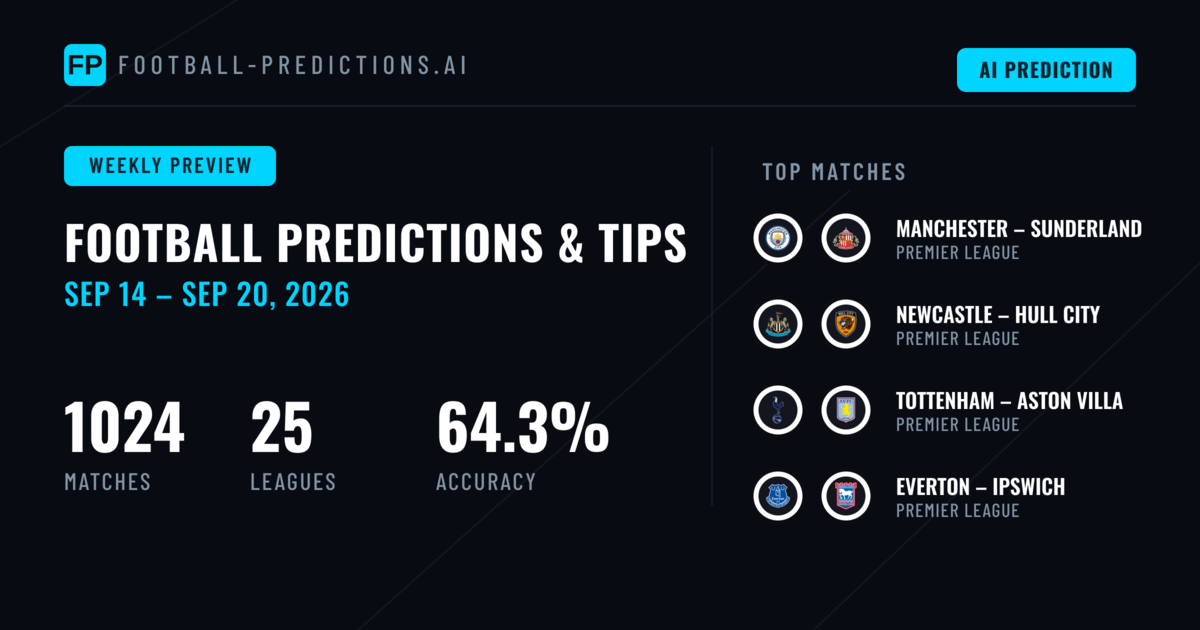
The Week Ahead: 1,024 Matches Set to Light Up Global Football
Football supporters across every continent face a feast of action this week as 1,024 matches populate the calendar from September 14 through September 20, 2026. The scope spans elite continental competitions, domestic cup action, and league fixtures across multiple countries, ensuring that armchair analysts and bettors alike will find no shortage of opportunities to assess form, fitness, and fixture congestion.
Among the standout competitions drawing attention this week, the UEFA Europa League continues its group stage with several teams looking to establish early command of their pools. South American club football's premier competition, the CONMEBOL Libertadores, also enters a crucial phase with several sides jostling for position in their respective groups. Domestically, English and Italian clubs turn their focus to cup matters, with the FA Cup and Coppa Italia producing early-round eliminators that offer smaller clubs the chance to test themselves against top-flight opposition.
With such a densely packed schedule, the week presents unique analytical challenges. Teams operating across multiple competitions must carefully manage squad rotation, while others may find themselves navigating congested fixture lists with minimal recovery time between outings. The geographical spread of matches means that analysis must account for varying conditions, travel demands, and the impact of recent international duty on player availability. These factors combine to create a landscape where unexpected results become not merely possible but statistically probable across the 1,024 encounters scheduled.
Midweek European and South American Showdowns Take Center Stage
The week ahead delivers a compelling mix of UEFA Europa League action and CONMEBOL Libertadores drama. From Mediterranean clashes to Balkan encounters and South American battles, these four fixtures pit teams in contrasting domestic situations against each other with plenty at stake in continental competition.
Hapoel Beer Sheva vs Dinamo Zagreb
 vs
vs 
A significant gap in current domestic form sets the tone for Wednesday's Europa League opener. Hapoel Beer Sheva vs Dinamo Zagreb sees the Croatian champions arrive in third place domestically while Hapoel sit third in their own league. The head-to-head record between these sides shows one draw and one away victory across two meetings, averaging 4.5 goals per encounter. Our model predicts a home win at 50% confidence, with both teams failing to score at 62% confidence. The high-scoring nature of their previous meetings suggests one goal may decide this contest.
Levski Sofia vs Red Bull Salzburg
 vs
vs 
Thursday brings a fascinating encounter as league leaders Levski Sofia welcome a Red Bull Salzburg side sitting third in their domestic standings. Levski Sofia vs Red Bull Salzburg presents a genuine tactical puzzle. Our model indicates a draw as the most likely outcome at 33% confidence, with under 2.5 goals backed at 57% and both teams to score evenly split at 50%. Salzburg's European pedigree gives them a slight edge on paper, but Levski's domestic dominance cannot be dismissed. Expect a tightly contested affair with few clear-cut chances.
Celtic vs Ferencvarosi TC
 vs
vs 
Celtic's domestic invincibility should carry them through Thursday's Europa League test against Ferencvarosi TC. Celtic vs Ferencvarosi TC sees the Scottish champions clear favorites with a home win predicted at 50% confidence. Ferencvarosi TC sit fifth in their league, creating a disparity in current form. The under 2.5 goals market carries the highest confidence of the week at 63%, while BTTS no receives 56% backing. Celtic have won two of their three previous meetings with Ferencvarosi, averaging 3.3 goals across those clashes. The Hungarian visitors must tighten their defensive shape significantly to avoid another setback.
Platense vs Fluminense
 vs
vs
Tuesday's Libertadores action delivers a battle between South American giants and domestic outsiders. Platense vs Fluminense features a side thirteenth in their league hosting the league leaders. Despite Fluminense's commanding domestic position, our model favors a draw at 33% confidence. The under 2.5 goals market receives 54% backing, while BTTS yes carries 60% confidence — the highest such figure across all four featured matches. This signals a contest where both defenses may bend but not completely break. Fluminense's superior quality should eventually tell, though Platense possess enough to trouble the Brazilian league leaders.

 AC Milan vs Benfica
Benfica travels to San Siro on Wednesday with the stronger league position, sitting second in the Portuguese top flight compared to AC Milan's fifth-place standing in Serie A. The data favors an away victory with 50% confidence, while the under 2.5 goals market shows stronger conviction at 60%. Neither side appears likely to score, with BTTS marked at 52% confidence against. Their sole previous meeting produced just one goal. A tight, low-scoring affair suits Benfica's current trajectory.

 Corinthians vs Estudiantes L.P.
Thursday's CONMEBOL Libertadores encounter sees Estudiantes L.P. backed to win despite sitting five places below Corinthians in their domestic league. The away side carries 45% prediction confidence into this fixture. Goals should be limited, with under 2.5 markets at 55%, though both teams finding the net remains the preferred outcome at 59%. The two-team head-to-head history shows one win each with an average of 1.0 goals per match.

 Sturm Graz vs Rennes
A draw emerges as the most likely outcome for this UEFA Europa League clash on Wednesday, with both teams occupying similar league positions—Sturm Graz fourth in Austria and Rennes third in Ligue 1. The prediction carries 33% confidence in a stalemate. Defensive solidity should prevail, with BTTS at 62% confidence for no goals from either side. Rennes' away form will face a stern examination against a well-organized Sturm Graz side on home soil.

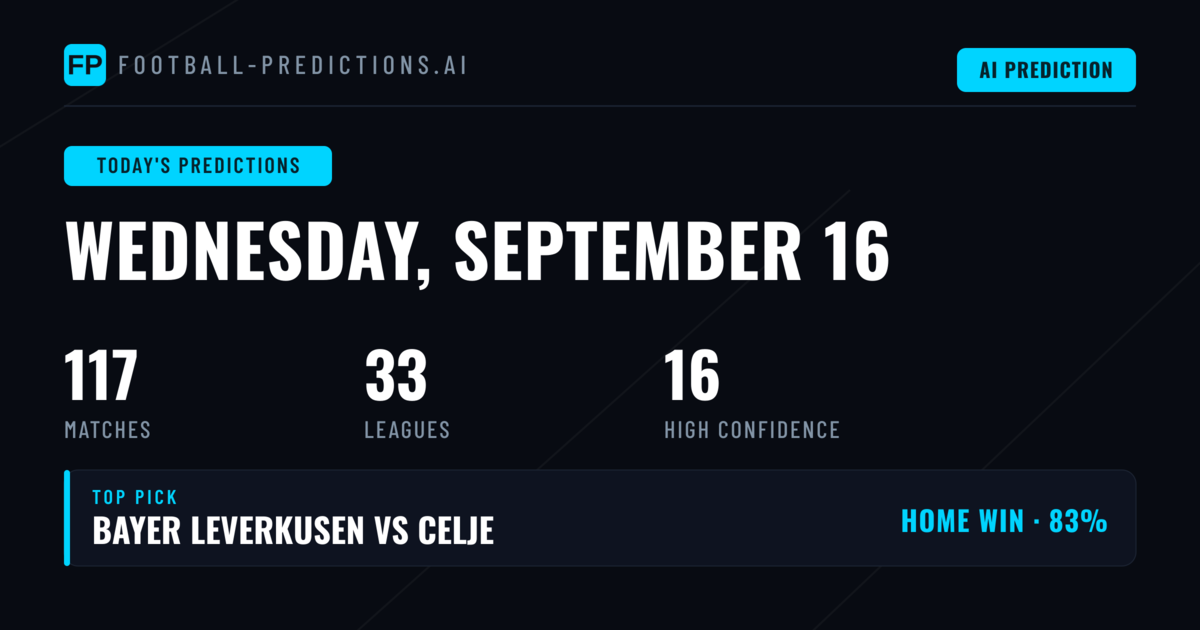
 Bayer Leverkusen vs Celje
The Bundesliga side hosts the Slovenian league leaders in a compelling UEFA Europa League fixture. Celje's top domestic standing makes this an intriguing underdog test against Leverkusen in seventh place. A draw registers at 33% confidence, suggesting a closely contested match in Germany. Both teams to score carries 62% confidence against, indicating expected defensive discipline. Celje's league-best record suggests they possess the quality to frustrate their higher-profile opponents.
Cup Competitions: Where Goals Flow and Giants Fall
 FA Cup
The 2025/26 FA Cup campaign confirmed why England's historic knockout competition remains the benchmark for dramatic cup football. Across 812 matches throughout the season, the tournament produced a remarkable 3.32 goals per game, a figure that consistently rewarded Over bettors while leaving defensive teams scrambling for solutions at every level of the English football pyramid. Home teams secured 1504 victories over the course of the campaign, illustrating the continued importance of home advantage even as lower-league clubs pushed established names to their limits. The combination of high-scoring encounters and unpredictable outcomes made the FA Cup a fertile hunting ground for those tracking attacking trends across domestic cup competitions.
 Coppa Italia
The Coppa Italia 2025/26 season carved its place in the record books as one of the most prolific attacking tournaments in recent memory. Thirty-three matches generated 91 goals at an average of 2.76 per game, a total that dwarfed typical cup norms and suggested a tournament where defensiveOrganisation took a back seat to entertainment. The 2026 edition continues this trajectory, with the attacking verve that defined the previous season showing no signs of diminishing as new contenders enter the fray. Teams progressing through the Coppa Italia this week will need to balance their natural attacking instincts with the tactical discipline required for cup survival, a challenge that has proven difficult for many throughout this exceptionally high-scoring cycle.
 CONMEBOL Libertadores
The CONMEBOL Libertadores 2026/27 campaign reaches its decisive phase with 118 matches already completed and the tournament at 83 percent completion. The group stage standings reveal a familiar pattern of South American giants asserting their authority alongside a handful of determined challengers. Flamengo sits atop the table with 16 points from six matches, having won five of their six encounters while suffering no defeats. Independ. Rivadavia matches Flamengo's tally exactly, also collecting 16 points through five wins and a single draw in their six fixtures. Both clubs carry identical form guides of WWDWW into their upcoming matches, suggesting momentum that could prove decisive as the group stage reaches its climax.
Below the leaders, U. Catolica holds third place with 13 points from four wins, one draw, and one defeat in their six matches. Corinthians occupies fourth position on 11 points, though their three wins, two draws, and single loss indicate a campaign that has lacked the consistency of the frontrunners. Coquimbo Unido rounds out the leading pack with 10 points, their campaign featuring three wins against two losses from six fixtures. The form guide of LWWLW suggests a team capable of building sequences but occasionally vulnerable to the intensity that defines continental competition at this stage. As the group stage enters its decisive phase, the tactical adjustments and squad rotation decisions made over the coming days will determine which of these five clubs advances with momentum rather than merely survival on their side.
In-Form Teams Lighting Up European Football
Several clubs enter the week riding remarkable unbeaten streaks, combining relentless attacking output with defensive solidity that has left opponents struggling for answers across domestic leagues. With 1024 fixtures scheduled between September 14-20, 2026, these sides represent the form teams worth tracking for any football enthusiast or analyst.
Celtic have set the benchmark in Scotland, sitting top of the Scottish Premiership with 18 points from 6 matches. Their record reads six wins from six attempts, conceding just three goals while finding the net 14 times. The attacking verve has been spearheaded by K. Høgh, who has plundered three goals in only two appearances. Celtic's domestic dominance now faces a different test as they prepare for UEFA Europa League action this week, with their first continental assignment presenting fresh tactical challenges.
 FC Porto mirror Celtic's perfection in Portugal, also collecting 18 points from six games with an identical six-win sequence. The Dragons have been particularly miserly at the back, shipping just two goals while rattling in 15 at the other end. Gabri Veiga has contributed one goal and one assist across two substitute appearances, suggesting creative threat from the bench. Porto's all-round Primeira Liga display positions them as heavy favourites whenever they next take domestic field.
 PSV Eindhoven lead the Eredivisie with 16 points from six matches, their record of five wins and one draw reflecting continued domestic authority. The Dutch outfit boast the most prolific attack among these form teams, plundering 22 goals already, though their defensive record of seven conceded shows occasional vulnerability. S. Dest has registered once in a single appearance, indicating goals are distributed across the squad. PSV take their momentum into another fixture this week, seeking to extend their advantage at the summit.
 Barcelona have made an explosive start to their La Liga campaign, collecting 15 points from five matches courtesy of five consecutive victories. Their goal difference reads an eye-watering plus-17, with 21 scored and four conceded, making them the most clinical outfit in Europe's top leagues relative to games played. Raphinha leads their charge with two goals and one assist from a single appearance, demonstrating immediate impact. Barcelona's relentless early-season form marks them as the team others must chase in Spain.
Benfica sit second in the Primeira Liga on 16 points, one behind rivals Porto, with their record showing five wins and one draw from six attempts. The Eagles have been equally devastating in attack, hitting 21 goals while conceding just four. V. Pavlidis has been clinical in front of goal, netting five times alongside one assist in just three appearances. Benfica now turn their attention to UEFA Europa League competition this week, where their domestic sharpness will face continental examination.
 Anderlecht begin their European journey this week in the Europa League, entering the group stage fresh from domestic success. The Belgian side had built a five-win sequence domestically before their focus shifted to continental matters. A. Bertaccini had found the net once across two appearances in prior competition, and the squad will aim to transfer domestic confidence onto the European stage when they face Celtic in their opening group fixture.
Reviewing Last Week's Predictions: A Mixed Week Across the Board
The week of Sep 7 to Sep 13 delivered a challenging test for our predictive model, with overall results reflecting the inherent unpredictability of competitive football. The 1x2 market proved particularly difficult, with our model landing 277 correct predictions out of 661 matches, translating to an accuracy of 41.9%. This represented a dip below our typical performance threshold, a reminder that even the most refined statistical models encounter stretches where results diverge from expectations.
More encouraging signals emerged in the goal markets. The Over/Under category performed solidly at 57.8% accuracy, with 338 correct calls from 585 predictions, while BTTS predictions hit the mark 54.6% of the time across 661 fixtures. The average goals per match stood at 2.92, and both teams found the net in 55.6% of fixtures, indicating a week characterised by attacking intent rather than defensive solidity across many competitions.
Placed against our longer-term track record compiled over approximately 90 days and 6,514 predictions, last week's 1x2 figure of 41.9% sits below the 48.8% baseline we have established over that sample. However, the Over/Under result at 57.8% came within touching distance of our 90-day figure of 58.2%, while the headline pick accuracy of 58.9% over the longer window provides a reliable anchor point for confidence. The Double Chance market has historically been our strongest performer at 75.9% across the 90-day window, a testament to the value of covering multiple outcomes in uncertain fixtures.
As we turn our attention to the 1,024 matches scheduled for this week, our model continues to process fresh data and recalibrate its outputs. The statistical foundations remain robust, and short-term variance is factored into our methodology. On our statistics page you can study our performance in detail across every bet type and in the context of all tournaments.
Corner Betting Predictions — AI-Powered Analysis & Tips
Table of Contents
- What Are Corner Betting Predictions?
- How Our AI Generates Corner Predictions
- Today's Corner Predictions Overview
- Types of Corner Bets Explained
- Key Factors That Influence Corner Counts
- Corner Betting Strategies
- Best Leagues for Corner Betting
- Common Mistakes in Corner Betting
- Corner Bets in Accumulators
What Are Corner Betting Predictions?
Corner betting is one of the most dynamic and data-driven markets in football wagering. Unlike match result or goalscorer bets, corner predictions focus entirely on a specific, measurable in-game event — the number of corner kicks awarded during a match. This market has gained tremendous popularity among sharp bettors because it's less influenced by individual moments of brilliance and more by sustained tactical patterns, team styles, and match context.
At its core, corner betting revolves around predicting whether the total number of corners in a match will be over or under a specified line (typically 9.5, 10.5, or 11.5). Some bookmakers also offer team-specific corners, Asian handicap corners, and exact corner totals. Our AI system analyzes historical corner data, team attacking tendencies, defensive structures, and venue factors to generate accurate predictions for every available match.
What makes corners particularly interesting is their relative independence from goals. A team can dominate possession, force numerous corners, and still lose the match 0-1. This disconnect between corners and match outcomes creates unique value opportunities that our AI exploits by focusing specifically on the metrics that drive corner counts rather than goals. It also means corner bets provide genuine diversification when combined with result-based markets.
The corner market is also less efficient than goals or match result markets. Bookmakers invest less modeling resource in corner pricing, creating wider margins but also more opportunities for informed bettors. Our AI systematically identifies these pricing gaps by comparing our projected corner distributions against offered odds across 29+ leagues.
How Our AI Generates Corner Predictions
Our corner prediction engine processes a rich set of statistical inputs that go far beyond simple averages. The algorithm considers each team's corner generation rate per 90 minutes, both home and away, the number of corners they concede, their crossing frequency, and their shot-blocking tendencies. A team that takes many long-range shots, for instance, is more likely to generate corners from deflections, while a side that plays narrow tends to produce fewer.
The model also incorporates contextual variables such as match importance, expected game state (will one team be chasing the game?), and head-to-head corner history. Matches between attacking teams in open leagues like the Eredivisie or Serie A tend to produce high corner counts, while defensive encounters in lower leagues may fall well under the line.
Tactical Pattern Recognition
The AI identifies specific tactical patterns that drive corners: teams that play with overlapping full-backs generate more crossing opportunities; teams that press high force opponents into long balls and defensive clearances that lead to throw-ins and corners; teams that deploy wide wingers create more touchline attacks that result in corner-winning crosses. These tactical fingerprints are more predictive than simple corner averages.
Game State Modeling
Expected game state significantly affects corner predictions. When our model predicts a home favorite will dominate possession and territory, it increases the corner expectation for that team while reducing the opponent's. Matches expected to be one-sided produce more corners from the dominant team's attacks, but fewer from the defensive team. The model captures this asymmetry rather than treating both teams equally.
Weather and pitch conditions also factor in where data is available. Wet pitches lead to more overhit crosses, while windy conditions at certain grounds systematically increase corner counts. The model weighs recent form (last 5-10 matches) more heavily than season averages, allowing it to capture teams that have shifted tactical approach mid-season — a common occurrence after managerial changes or key injuries.
Today's Corner Predictions Overview
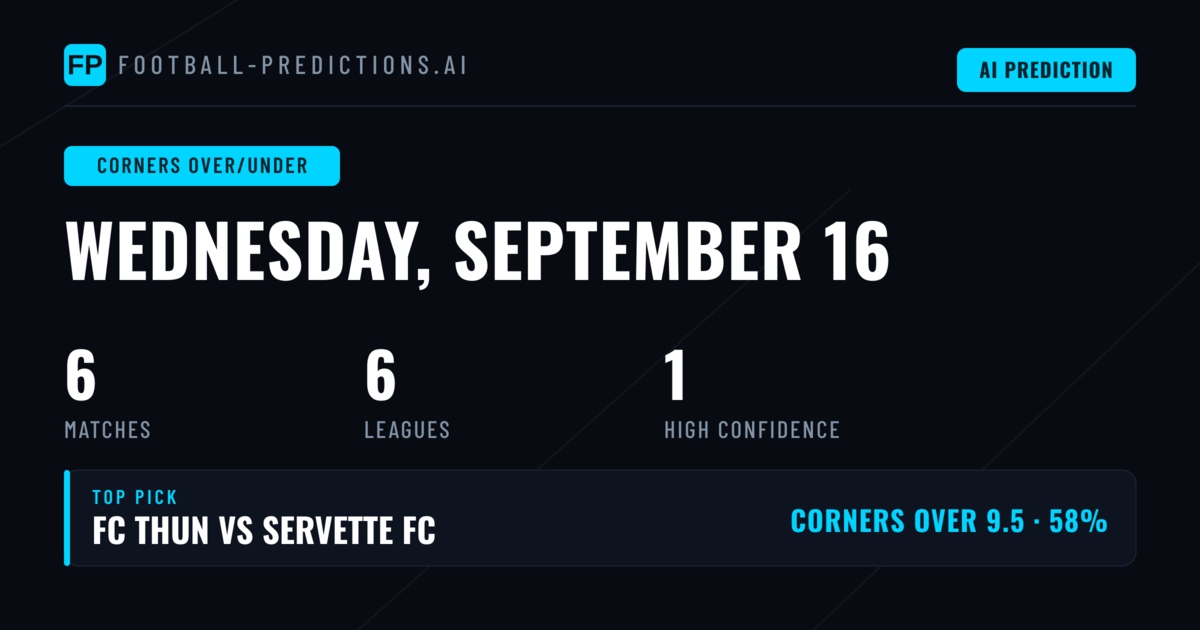
Our platform currently tracks 103 matches across 29 leagues with corner predictions available for 62 fixtures today. These predictions are refreshed multiple times daily as new data becomes available, odds shift, and team news emerges.
| Metric | Value |
|---|---|
| Total matches analyzed | 103 |
| Leagues covered | 29 |
| Corner predictions | 62 |
| Over picks | 72 |
| Under picks | 37 |
| Top confidence pick | under 9.5 (Monagas SC vs Zamora FC) |
| Highest confidence | 68% |
| Best odds available | 1.87 |
For detailed accuracy breakdowns across all bet types, visit our prediction statistics page.
Types of Corner Bets Explained
The corner betting market offers several variations, each suited to different strategies and risk appetites:
Total Match Corners (Over/Under)
The most popular market. You bet on whether the combined corner count will be over or under a specific line. Lines typically range from 8.5 to 12.5 depending on the match. Premier League matches average around 10-11 corners, while some defensive leagues average 8-9. Our AI picks the optimal line for each match rather than using a fixed threshold, comparing probabilities against odds for multiple lines to find the best value.
Team Corners (Over/Under)
You can bet on how many corners a specific team will win. This is valuable when one team is significantly stronger in attack — for example, Manchester City at home may be expected to win 6+ corners regardless of their opponent. Team corners isolate the attacking output of one side and remove the noise from the opposition. Lines are typically 4.5-6.5 per team, with odds that are often less efficiently priced than total match corners.
Asian Handicap Corners
Similar to match result Asian handicaps, this gives one team a virtual corner advantage. If Team A has a -2.5 corner handicap, they need to win at least 3 more corners than their opponent. This market is excellent for matches with a clear disparity in attacking quality. Quarter lines (-2.25, -2.75) are also available, providing the same partial-refund mechanics as match AH.
Corner Race Markets
Some bookmakers offer "Race to X Corners" — which team will reach 3, 5, or 7 corners first. This market is popular for in-play betting but can also be predicted pre-match based on teams' early pressing intensity and attacking style in opening minutes. Teams that start matches aggressively and press high tend to reach corner milestones first.
First-Half Corners
Corner over/under markets specific to the first half, typically with lines around 4.5-5.5. First-half corner patterns can differ significantly from full-match patterns — some teams generate most of their corners in the opening 45 minutes due to high-intensity pressing that fades in the second half. This market offers interesting value because bookmakers often set first-half lines as a simple proportion of the full-match line rather than modeling first-half dynamics separately.
Understanding what drives corner counts is essential for evaluating our AI's predictions and developing your own intuition for this market:
Attacking Style and Width
Teams that play with wide wingers and rely on crosses naturally generate more corners. Full-backs who overlap into advanced positions create additional crossing opportunities. Conversely, teams that build through the center and look for through balls will generate fewer corners but more scoring chances. The width of a team's attacking play is the single strongest predictor of their corner generation rate.
Defensive Block Height
When a team defends deep in a low block, attackers are forced wide more often. This leads to more crosses, more blocks, and ultimately more corners. Matches where the underdog sits deep and absorbs pressure tend to produce high corner counts, especially from the dominant team. Paradoxically, the defensive team contributes to the attacking team's corner tally by blocking crosses and shots at the edge of the box.
Shot Volume and Accuracy
Shots that are blocked or deflected frequently result in corners. Teams with high shot volumes but moderate accuracy — those that shoot from distance or from tight angles — tend to generate corners at a higher rate than teams that are clinical finishers. A team averaging 15+ shots per match with only 40% on target will produce more corners than one averaging 10 shots with 60% accuracy.
Match State and Tempo
The game state significantly affects corner frequency. When a team is trailing, they push forward more aggressively, creating more crossing opportunities and corners. Matches where the favorite is expected to dominate possession and territory typically produce more corners than balanced encounters. Late-game desperation (chasing a goal in the final 15-20 minutes) produces a disproportionate number of corners.
Venue Factors
Home teams consistently win more corners than away teams — typically 1-2 more per match. Some grounds with narrow pitches funnel play wide, while others with larger dimensions allow teams to switch play more easily. Historical venue data shows certain stadiums averaging 2-3 more corners per match than others, a factor our AI captures through venue-specific modeling. Grounds with tight dimensions like Anfield and the Mestalla tend to produce above-average corner counts.
Weather and Pitch Conditions
Wind affects crossing accuracy and can turn routine clearances into corners. Wet pitches make the ball skid faster, leading to more overhit crosses and goal kicks that become corners. These environmental factors are harder to model but can add 1-2 corners to a match when conditions are extreme. Our AI factors in weather data for matches where it's available.
Corner Betting Strategies
Effective Approaches
- Focus on team-specific corner markets for clearer edges
- Use first-half corner lines — they're less efficiently priced
- Target matches where a strong attacking team faces a deep-defending opponent
- Track teams' corner stats in last 5 home/away matches specifically
- Consider Asian handicap corners to reduce variance
- Cross-reference our AI confidence with your own team knowledge
Common Pitfalls
- Don't assume high-scoring matches always have many corners
- Avoid using full-season averages without considering recent form
- Don't ignore the impact of managerial changes on corner patterns
- Never chase corners in-play after an unusually slow first half
- Don't bet corners in matches with heavy rotation or dead rubbers
- Avoid corner bets in weather-affected matches without checking conditions
First-Half Corner Strategy
First-half corner lines are typically set around 4.5-5.5. The opening period of matches tends to be more predictable for corners because teams follow their tactical plans more rigidly. As the match progresses, substitutions, tactical shifts, and game state create more variability. Backing overs in the first half when two attacking teams meet can provide consistent value, especially in the Bundesliga and Premier League where first-half pressing intensity is high.
Value in Under-Priced Unders
The public tends to prefer overs in corner markets, which can push unders into value territory. When two defensively-minded teams meet — or when rain is expected to slow play — under the corner line can be a smart contrarian pick. Our AI identifies these situations by analyzing both teams' defensive metrics and possession patterns. Matches between teams that play narrow, possession-based football and rarely cross the ball are prime under candidates.
The Dominant Team Strategy
When a strong attacking team faces a deep-defending underdog, back the dominant team's individual corner total rather than the match total. The underdog will generate very few corners (perhaps 2-3), but the attacking team may win 7-8 alone. Bookmakers sometimes set the match total conservatively because they factor in the low corner count from the defensive team — but the dominant team's individual line may be set too low.
Best Leagues for Corner Betting
Not all leagues are created equal when it comes to corner betting. Some leagues have consistently high corner counts due to playing styles, while others offer more predictable patterns that favor betting:
| League | Avg Corners/Match | Best Market | Why |
|---|---|---|---|
| Premier League | 10.5-11.0 | Over 9.5 / Team Corners | Wide play, high crossing volume |
| La Liga | 9.5-10.0 | Asian Handicap Corners | One-sided attacks, low under teams |
| Serie A | 10.0-10.5 | Over 10.5 | Tactical attacks with set-piece focus |
| Bundesliga | 10.0-10.5 | First Half Corners | Intense pressing in opening 45 mins |
| Eredivisie | 10.5-11.5 | Over 10.5 | Open, attacking, highest corner rate |
| Championship | 10.5-11.0 | Over 9.5 | Physical play, many blocked shots |
| Ligue 1 | 9.5-10.0 | Under 10.5 | Conservative, fewer crossing attacks |
The Eredivisie and English Championship tend to produce the highest corner counts due to their open, attacking styles of play. Ligue 1 and La Liga, with more tactical and possession-based approaches, often fall below the 10-corner mark. Our AI adapts its line selection based on league-specific patterns, never applying a one-size-fits-all threshold.
For corner betting beginners, the Premier League offers the best combination of data availability, predictable patterns, and market liquidity. The high average corner count (10.5-11) means over 9.5 lines hit frequently (65%+), providing a reliable base for building corner betting strategies.
Common Mistakes in Corner Betting
Ignoring the referee factor: Some referees are more lenient with goal kicks vs. corners on marginal decisions. While this data isn't always available, major leagues track referee tendencies. A strict referee who awards corners on 50/50 decisions can add 1-2 corners to a match. Where possible, check the appointed referee before finalizing corner bets.
Overweighting single matches: A team that won 15 corners in their last match may have been an outlier — perhaps they had a red card against them and attacked desperately. Look at 5-10 match rolling averages rather than single data points. Our AI uses weighted rolling averages to smooth out these outliers.
Neglecting away corner drops: Teams that average 6 corners at home may only win 3-4 away. The home/away split for corners is significant and should always be factored into predictions. Our AI handles this by maintaining separate home and away corner models for every team.
Correlation with goals assumption: Corners and goals have a weaker correlation than most bettors assume. Matches can be high-scoring with few corners (if goals come from counter-attacks and through balls) or low-scoring with many corners (if attacks are blocked repeatedly at the edge of the box). Treat corners as an independent market with its own drivers.
Corner Bets in Accumulators
Corner bets can be excellent additions to accumulators because they have lower correlation with match results. Including a corner over/under alongside a match result bet creates genuine diversification, as the outcomes are partially independent events.
Example Corner Accumulator
| Match | Pick | Odds |
|---|---|---|
| Premier League — Over 10.5 Corners | Over | 1.90 |
| Bundesliga — Over 9.5 Corners | Over | 1.85 |
| Championship — Over 10.5 Corners | Over | 1.80 |
Combined odds: ~6.33 — A focused treble using attacking league profiles where corner overs hit consistently.
When building corner accumulators, stick to 2-4 selections to manage variance. Corner outcomes in different matches are nearly independent, making the multiplication of probabilities more reliable than match result accas. For AI-curated corner accumulator suggestions, visit our accumulator tips page.
Another effective approach is mixing corner bets with other markets — for example, combining a match result bet with a corner over in the same match. This "same-game multi" leverages the low correlation between corners and goals to create accumulators with independent legs. Our AI confidence ratings help identify the strongest corner picks to include in your accumulators.
Corner unders can also work well in accumulators for more conservative strategies. Three matches featuring Under 10.5 at 1.85-2.00 each in defensive leagues (Ligue 1, lower Serie A) can combine for 6.00-8.00 combined odds with reasonable hit rates. The key is targeting consistently low-corner matchups where both teams play narrow, possession-based football.
View today's corner prediction for every football match. Our AI analyses team corner averages, attacking styles, possession stats and league trends to deliver accurate corners predictions today. Corner kick prediction is a fast-growing betting market — we cover over/under corner lines including over 9.5 corners prediction today for high-action matches. Whether you need today's corner prediction for the Premier League or any league, our corner bet analysis uses the best corner prediction methodology across 178+ competitions.
Corners Predictions FAQ
How accurate are your corner predictions?
Our AI analyzes corner statistics from 29+ leagues, tracking team-specific corner generation and concession rates. Accuracy varies by league but our highest-confidence picks (68%+) have the strongest track record. Check our stats page for detailed accuracy breakdowns.
What does Over/Under mean for corners?
Over/Under corners works like goals O/U — you bet on whether the total corners in a match will exceed or fall below a set line (e.g., 9.5). If the line is 9.5 and the match has 11 corners, Over wins. Currently 72 of our 62 predictions today are Overs.
Which leagues have the most corners?
The Premier League, Eredivisie, and English Championship consistently produce the highest corner counts (10.5-11.5 per match). Ligue 1 and some South American leagues tend to have fewer corners. Our AI adjusts predictions based on league-specific averages.
Can I bet on corners in live matches?
Yes, in-play corner betting is very popular. Our pre-match predictions give you a baseline expectation — if a match is tracking below the predicted corner pace at half-time, live overs may offer value. Always compare live stats to our pre-match projections.
How do team corners differ from match corners?
Match corners count all corners from both teams, while team corners focus on one side only. Team corner lines are typically 4.5-6.5 per team. This market is useful when one team is significantly more attacking — our top pick today is under 9.5 in Monagas SC vs Zamora FC.
Should I include corner bets in accumulators?
Corner bets make excellent accumulator additions because they have low correlation with match results. A team can lose but still win many corners. Keep corner accas to 2-4 legs for manageable variance. Visit our accumulator tips page for AI-curated corner acca suggestions.